wedding alcohol calculator
How Much Alcohol to Buy for a Wedding: A 2026 Guide
Work out how much alcohol to buy for a wedding with bottle counts, toast quantities and a practical shopping checklist for Orange County couples.
By BeeHive Mobile Bar ··12 min read
In this guide
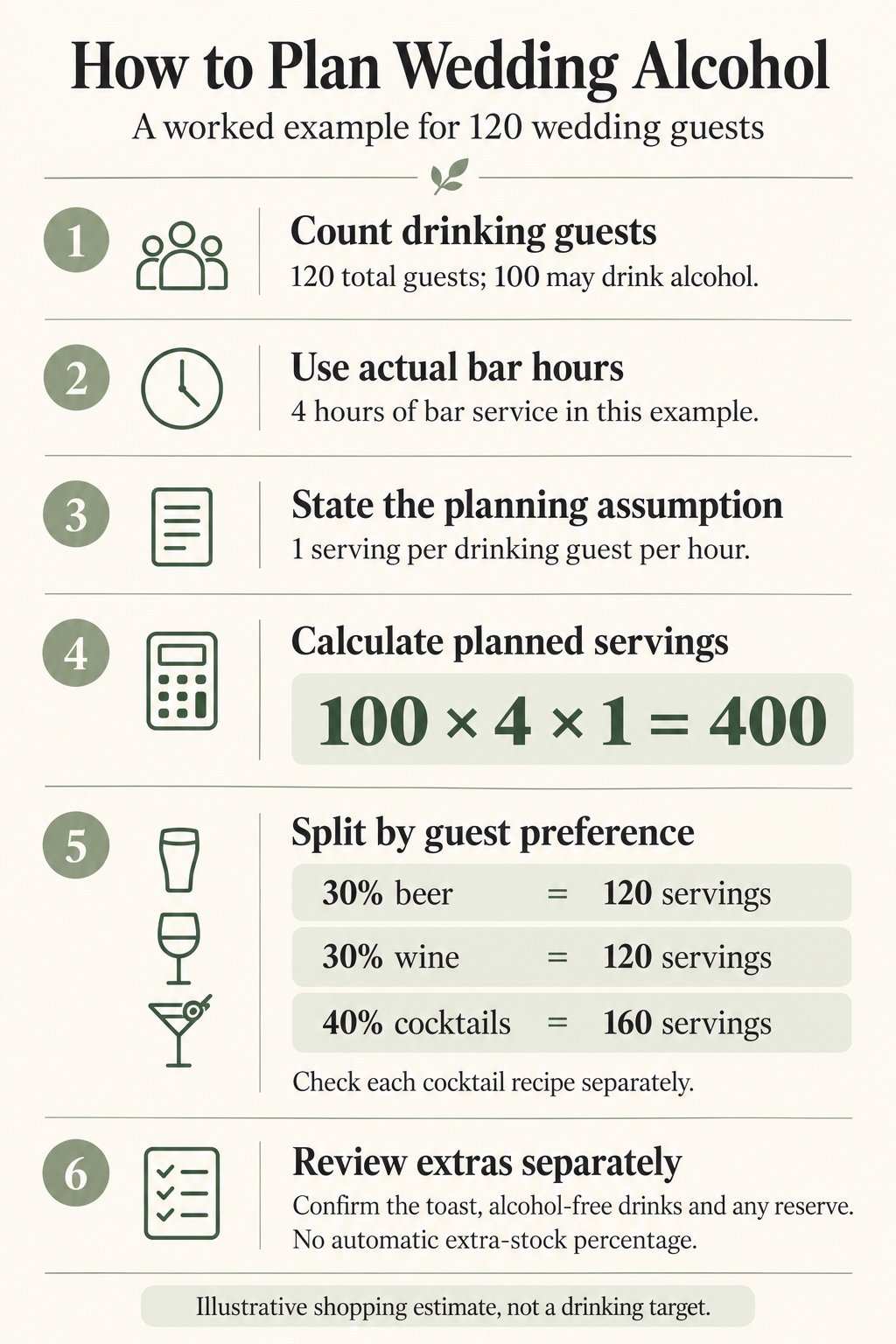
To calculate how much alcohol to buy for a wedding, count the guests who may drink alcohol, choose a purchasing estimate for your actual bar-service hours, then divide the total among beer, wine and cocktails. Convert those servings into cases and bottles, and check each cocktail ingredient separately.
For example, 100 guests who may drink alcohol, four bar hours and an inventory assumption of one serving per hour produce 400 planned alcoholic servings. That figure is a shopping scenario, not a drinking target. Your menu, guest preferences and service timeline determine whether it is appropriate.
This guide walks through the quantities for a wedding with 120 total guests, including 100 who may drink alcohol. It also separates a dedicated sparkling-wine toast, alcohol-free drinks and the supplies your host, venue or BeeHive package will provide.
Quick conversions for wedding alcohol shopping
Use measured pours and consistent units. The table below uses US fluid ounces and 750 ml bottles, each containing approximately 25.36 fluid ounces.
| Item | Planning yield | How to calculate the purchase |
|---|---|---|
| Beer case with 24 cans or bottles | 24 individual beers | Planned beer servings ÷ 24, rounded up; confirm the actual pack size |
| 750 ml wine bottle | About five 5-ounce pours | Planned wine servings ÷ 5, rounded up |
| 750 ml spirits bottle at a 1.5-ounce pour | 16.9 pour-equivalents; 16 complete pours from one bottle, with a remainder | Servings × 1.5 ÷ 25.36, rounded up for each ingredient |
| 750 ml spirits bottle at a 2-ounce pour | 12.7 pour-equivalents; 12 complete pours from one bottle, with a remainder | Servings × 2 ÷ 25.36, rounded up for each ingredient |
The approximate five-pour wine yield agrees with NIAAA's bottle-to-serving guidance. For spirits, combine the volume needed across recipes using the same ingredient before rounding to whole bottles. Usable remainders can contribute to later measured drinks; spills, over-pouring and an agreed reserve are separate considerations.
Keep menu servings separate from alcohol content
Under NIAAA's standard-drink definition, a US standard drink contains about 0.6 fluid ounces, or 14 grams, of pure alcohol. Examples are 12 ounces of 5% beer, 5 ounces of 12% wine and 1.5 ounces of 40% spirits.
A larger or stronger drink can contain more alcohol even when it counts as one order. CDC's standard-drink guidance explains this distinction. A cocktail with a base spirit and liqueur is not automatically one standard drink, and a beer can’s volume alone does not establish its strength.
Calculate the reception total using one consistent guest count
Start with confirmed attendance, then identify how many guests may drink alcohol. For our example:
Total guests: 120.
Guests who may drink alcohol: 100.
Bar-service time: four hours, excluding any closure before or after service.
Inventory assumption: one serving per hour for each guest who may drink.
100 × 4 × 1 = 400 planned alcoholic servings. The other 20 guests need alcohol-free options, and those options should also be available to guests who alternate drinks or stop drinking alcohol during the reception.
Use bar hours, rather than the full venue rental period. Confirm whether service pauses during the ceremony, dinner or speeches. Guests arriving late or leaving early can change demand, so review the estimate against the timeline.
BeeHive’s calculator also offers “1 per hour + 1 extra.” With the same 100 drinking guests and four hours, that produces 500 planned servings. This adds one serving per drinking guest across the whole event; it does not add another service hour. Choose the assumption deliberately and carry it through the whole shopping list.
Neither option guarantees what guests will order. Record your assumptions instead of treating a generic drinks-per-person rule as a fixed requirement.
Choose the beer, wine and cocktail split
Ask about broad beverage preferences when collecting RSVPs, then check them against your menu. The shares below are hypothetical alternatives for the same 400-serving reception estimate. Each row totals 100%; none includes a separate toast.
| Guest preference | Beer / wine / cocktails | Beer: 24-packs | Wine: 750 ml bottles | Combined base spirits: 750 ml bottles |
|---|---|---|---|---|
| Mixed preferences | 30% / 30% / 40% | 5 for 120 beers | 24 for 120 servings | 10 for 160 cocktails |
| Beer-forward | 55% / 25% / 20% | 10 for 220 beers | 20 for 100 servings | 5 for 80 cocktails |
| Wine-forward | 25% / 55% / 20% | 5 for 100 beers | 44 for 220 servings | 5 for 80 cocktails |
| Cocktail-focused | 20% / 20% / 60% | 4 for 80 beers | 16 for 80 servings | 15 for 240 cocktails |
Beer assumes one 12-ounce container per serving; wine assumes a 5-ounce pour. The spirits column assumes 1.5 ounces of base spirit per cocktail and combines that volume before rounding. It is a starting total, not a recipe-specific shopping list. Liqueurs and other alcoholic ingredients are additional, and splitting the total between spirits can require more bottles.
For the beer-forward row, 220 ÷ 24 = 9.17 cases, so buy 10 cases containing 240 beers. The wine calculation is 100 ÷ 5 = 20 bottles. The base-spirit calculation is 80 × 1.5 ÷ 25.36 = 4.73 bottles, rounded up to five.
For a beer-and-wine-only reception, set the cocktail share to zero and divide the same total between the two categories. A 40% beer / 60% wine example would be 160 beers and 240 wine servings: seven 24-packs and 48 wine bottles. Adjust the mix to your guests.
Use BeeHive’s calculator to check the reception estimate
Enter 120 total guests, 100 guests who may drink, four bar hours, 30% beer and 30% wine. Choose “1 per hour” and the standard 1.5-ounce liquor setting.
Open BeeHive’s Alcohol Calculator →
These settings give 400 planned servings, five beer 24-packs, 24 wine bottles and ten combined liquor bottles. The calculator does not add a separate toast, mixers, water, ice or an automatic reserve.
Convert the cocktail share into an ingredient list
For the mixed-preference example, split the 160 expected cocktail orders between two drinks: 80 vodka cocktails and 80 tequila cocktails, each using 1.5 ounces of its base spirit. Suppose the tequila recipe also uses 0.5 ounce of orange liqueur. These are illustrative measures; use the recipes agreed for your event.
| Ingredient | Recipe calculation | Quantity to buy |
|---|---|---|
| Vodka | 80 × 1.5 = 120 US fl oz, about 3,549 ml | Five 750 ml bottles |
| Tequila | 80 × 1.5 = 120 US fl oz, about 3,549 ml | Five 750 ml bottles |
| Orange liqueur | 80 × 0.5 = 40 US fl oz, about 1,183 ml | Two 750 ml bottles |
The result is ten base-spirit bottles plus two liqueur bottles. The calculator’s ten-bottle figure covers the base spirits in this example; it does not include the liqueur. Recalculate if the recipes use larger pours or additional ingredients.
Use the same method for mixers. If the 80 vodka cocktails each need 3 ounces of juice, that recipe requires 240 ounces. Four 64-ounce containers provide 256 ounces. This is a sample quantity calculation, not a BeeHive cocktail recipe or a reason to duplicate mixers already included in your package.
Plan the toast without counting it twice
Decide whether guests will raise the drinks already in their hands or receive a separate sparkling-wine pour. A toast with existing drinks does not require another glass for every person. A dedicated toast needs its own quantity and service plan.
For a separate toast with all 120 guests, suppose 100 choose sparkling wine and 20 choose alcohol-free sparkling drinks. At a 3-ounce pour:
| Toast choice | Calculation | 750 ml bottles |
|---|---|---|
| Sparkling wine | 100 × 3 = 300 US fl oz, about 8,872 ml | 12 |
| Alcohol-free sparkling drink | 20 × 3 = 60 US fl oz, about 1,774 ml | 3 |
That is 15 bottles and 120 glasses before any agreed spares. The Champagne Toast Calculator gives the same result with a 3-ounce pour and 0% extra allowance.
In this example, the dedicated toast is additional to the 400 reception servings. If your original estimate already included it, allocate those servings to the toast instead of adding them again. Confirm who purchases, chills, opens and pours each beverage and who supplies the glasses.
Assign mixers, water and supplies before shopping
A complete list records the item, quantity, provider and delivery plan. Use this as a working checklist, then fill in the agreed quantities and a named contact for each responsibility.
| Item | Planning basis | Who provides it? |
|---|---|---|
| Reception alcohol | Chosen mix plus recipe-by-recipe ingredient totals | Client purchases and provides all alcohol |
| Dedicated toast | Participants × selected pour; separate alcoholic and alcohol-free choices | Client buys alcohol; confirm other drinks, glasses and pouring arrangements |
| Mixers and garnishes | Recipe amount × expected orders; combine shared ingredients | Mobile-bar package for the agreed menu, or client for bartender-only service |
| Water and alcohol-free drinks | All guests, service periods, preferences and outdoor conditions | Gold inclusions, an agreed add-on or client supply |
| Ice and cooling | Separate drink ice from bottle-chilling needs; confirm storage and replenishment | Package includes ice and coolers; bartender-only clients arrange them |
| Drinkware, napkins and straws | Drink styles, expected servings, reuse and backup stock | Package plastic glassware and supplies, or client/venue arrangements |
| Handwashing, waste and leftover stock | Venue facilities, cleanup responsibilities and end-of-night access | Assign a venue or host contact; confirm any equipment needed |
Gold includes soft drinks and water; the listed add-on rate outside Gold is $3 per drink. A Refreshment Station starts at $125 and is included in Gold. The Slushie Machine starts at $215; one station provides one flavor, and a second flavor requires a second station. Confirm any requested add-ons in the proposal before assigning purchases.
Match the service to your wedding setup
BeeHive is based in Orange County and provides dry-hire mobile bartending. You purchase the alcohol using our shopping list. We do not buy, sell, supply, transport or deliver alcohol.
| Service | Starting price and minimum | Guest and menu guidance |
|---|---|---|
| Bronze | From $750; three-hour minimum | Up to 70 guests, one bartender, two signature cocktails |
| Silver | From $1,150; three-hour minimum | Up to 120 guests, two bartenders, three signature cocktails |
| Gold | Custom quote; three-hour minimum | 120+ guests, two or more bartenders, four signature cocktails |
| Bartender-only | From $350; two-hour minimum | Staffing and service scope confirmed in the proposal |
Mobile-bar packages include the bar, professional bartending, tools, ice, coolers, mixers, garnishes, plastic glassware, napkins, straws, setup and breakdown, and a custom printed menu. Bartender-only service includes professional bartending, tools, a shopping list, and setup and cleanup of the bartending work area; the client or venue arranges the other supplies.
The optional $150 mobile bar add-on for bartender-only service provides the mobile bar only. It does not include package supplies or turn the booking into a full mobile-bar package.
Guest ranges are planning guidance. Use the Bartender Staffing Calculator as a starting point, then confirm staffing against the cocktail menu, service pace, separate stations and any scheduled toast.
Additional bartender-only hours are $75 per hour. Extra service hours for Bronze, Silver and Gold are $100 per hour per bartender. Your proposal confirms the final service hours and charges.
California Alcoholic Beverage Control explains that hosts must purchase alcohol in advance for the mobile-bartending arrangement described in its FAQ. This supports BeeHive’s host-purchased-alcohol model; confirm the venue’s own requirements as well. Our bar service planning sequence can help organize access, setup and supplier responsibilities.
Finalize the order, reserve and event-day handoff
Confirm the menu and guest preferences before purchasing. Order specialty products early enough for availability, but do not impose a fixed “beer and wine last” rule: retailer lead times, delivery windows, refrigeration and venue access should drive the schedule.
Agree the assumptions: drinking guests, service hours, beverage shares and recipe measures.
Check the rounded quantities: note the extra servings already created by whole cases and bottles.
Choose any reserve once: list it separately, focusing on products that would be difficult to replace.
Assign the handoff: identify who buys, receives, chills and stages the host-purchased alcohol.
Arrange the finish: confirm retailer return conditions, venue storage and who removes leftover stock.
Do not assume a 10–15% buffer is always needed or that a retailer will accept unopened returns. Check the final menu and what rounding already provides. Our wedding alcohol budget guide helps connect these quantities to the alcohol purchase budget, separate from bartending fees.
A 25% deposit confirms a BeeHive booking; your proposal shows the remaining balance and due date. Southern California service outside Orange County is arranged individually, and travel fees may apply.
Planning your wedding bar? Send BeeHive Mobile Bar your date, city, guest count, venue details and service hours for a quote and an alcohol shopping list matched to your celebration.