wedding alcohol budget
Wedding Alcohol Budget: A Practical Planning Guide
Build a realistic wedding alcohol budget with step-by-step planning, allocation tips, and cost-control strategies for Orange County couples.
By BeeHive Mobile Bar ··14 min read
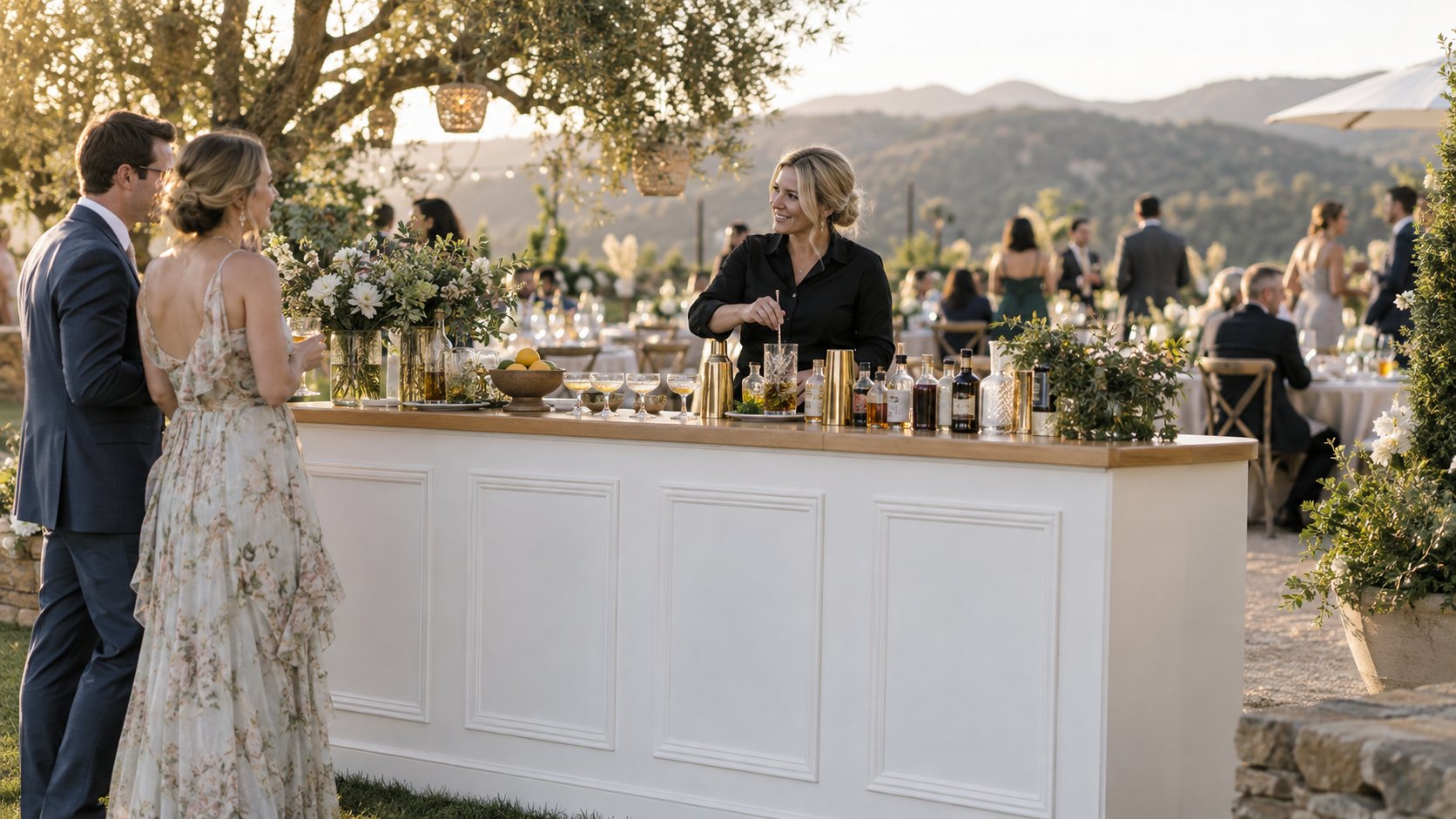
Alcohol is often purchased separately from bar service and venue charges, which is why a realistic wedding alcohol budget should start with the full bar plan, not just the bottle count. In practice, couples may need to budget for three separate buckets: the alcohol they buy, the bar service package they book, and any venue-specific fees or rules that apply.
That separation matters because the bar proposal and the alcohol shopping list are not the same thing. A service package can include bartenders, bar setup, mixers, ice, equipment, and cleanup, while the alcohol itself is purchased separately. Venue policies can then add their own layer, such as corkage, approved vendor requirements, service fees, or restrictions on outside alcohol.
For Orange County couples, the practical question is not "What does each drink cost?" It is "What will the total bar budget be once alcohol, service, and venue charges are all accounted for?" That is where a dry-hire model changes the planning process. With BeeHive Mobile Bar, clients buy all alcohol using a tailored shopping list that is included with every package. We do not sell, purchase, or deliver alcohol. Our packages include the service side of the bar so the alcohol budget can be planned separately and more clearly.
Table of Contents
- Why the Wedding Alcohol Budget Needs Its Own Plan
- The Line Items That Actually Make Up the Bar Budget
- Estimating Drinks by Guest Count and Service Length
- Allocating the Budget Across Beer, Wine, and Spirits
- Practical Levers to Control Wedding Alcohol Costs
- A One-Week Timeline to Finalize the Shopping List
- Wedding Alcohol Budget Questions Answered
Why the Wedding Alcohol Budget Needs Its Own Plan
A wedding bar deserves its own budget line because it combines alcohol purchases, bar service, and venue rules. Treating it as a vague reception add-on makes it easy to miss costs that appear later in the planning process.
For example, a couple might compare alcohol store prices and assume that is the full bar cost, then later realize the service package, venue fees, gratuity policy, and service-hour minimums need to be budgeted separately. Looking at the complete structure from the start gives you a more useful number.
Traditional venue bars often bundle alcohol, labor, overhead, and margin into one per-person or package price. That can be convenient, but it may also make it harder to see what portion of the bill is for product and what portion is for service.
Start with total bar budget
Use this framework before approving a bar plan:
Alcohol purchase: beer, wine, spirits, and any separate toast bottles.
Bar service package: bartenders, portable bar, mixers, ice, coolers, bar equipment, plastic glassware, napkins, straws, standard garnishes, printed menu, setup, service, and breakdown.
Venue charges: corkage, required staffing, approved vendor rules, overtime rules, and service fees if applicable.
Gratuity: confirm whether it is optional, included, or added by policy.
Practical rule: Never approve a bar plan until you can identify what you are buying separately, what is included in the service package, and what the venue may still charge.
Why dry hire changes the math
A dry-hire model separates the alcohol purchase from the bar service. You buy the alcohol yourself using a tailored shopping list, while the mobile bar provider handles the service side of the event.
That does not automatically make every event cheaper, but it does make the budget easier to review. You can see the alcohol quantities directly, keep the menu focused, and compare venue rules against a defined service package.
With BeeHive Mobile Bar, every package includes a tailored alcohol shopping list. Clients buy all alcohol themselves. BeeHive does not sell, purchase, or deliver alcohol.
The Line Items That Actually Make Up the Bar Budget
A useful Orange County bar budget starts with the final structure, not just the drink menu. Separate what is included in the bar package from what must still be purchased separately.
The most commonly overlooked items are venue charges, extra service hours, gratuity policy, and separate add-ons such as soft drinks, water, signature refreshments, or a toast. Alcohol itself is important, but it is only one part of the total bar budget.
| Item | How to budget for it |
|---|---|
| Alcohol purchase | Buy separately using the tailored shopping list included with every BeeHive package. BeeHive does not sell, purchase, or deliver alcohol. |
| BeeHive bar package | Budget the package price for service and included supplies. All packages include professional bartender(s), styled portable bar, mixers, ice, coolers, bar equipment, plastic glassware, napkins, straws, standard garnishes, printed menu, and complimentary setup and breakdown. |
| Venue charges | Ask the venue about corkage, outside alcohol rules, approved vendor requirements, access windows, and any service fees or overtime rules. |
| Extra service hours | Add $100 per hour, per bartender when service extends beyond the included package timing. |
| Soft drinks and water | Budget $3 per drink when added separately. Included in Gold. |
| Signature refreshment | Budget from $125 if desired. Included in Gold. |
| Slushie service | Budget from $210 if desired. |
| Gratuity | Add 20% to the total when tip jars are not permitted. |
The goal is to avoid counting the same item twice. If mixers, ice, garnishes, or plastic glassware are already included in the BeeHive package, they should not also be added again to the shopping list.
What you can shop
Alcohol product is the main category the client purchases separately when the venue allows it. The tailored shopping list helps translate guest count, bar hours, and menu choices into a practical order for beer, wine, and spirits.
That separation is helpful because it keeps the shopping list focused on alcohol only. With BeeHive, mixers, ice, coolers, bar equipment, plastic glassware, napkins, straws, standard garnishes, printed menu, and setup and breakdown are already included in the package.
For a clearer explanation of how alcohol purchasing and bartending can be separated, review how dry-hire mobile bar service works.
What the venue may control
Venue policies can determine whether you can bring in outside alcohol at all. Some properties require venue-purchased beverages, impose corkage, require approved bartenders, or set strict load-in, load-out, and service-hour rules.
A dry-hire arrangement gives you clearer separation between alcohol purchasing and bar service, but venue rules still need to be checked early. Get every fee and restriction in writing before locking the bar model.
Estimating Drinks by Guest Count and Service Length
Guest count alone is not enough. Expected drinkers, bar hours, and menu structure shape the shopping list far more accurately than a rough per-person guess.
For planning purposes, BeeHive's website calculator uses an hours-plus-one purchasing assumption. That is an inventory estimate, not consumption advice. It is designed to help build an alcohol shopping list, while water, alcohol-free drinks, mixers, ice, garnishes, and any separate toast are excluded from the calculator even though relevant service supplies are included in a BeeHive package.
Work through the timeline
For 100 total guests, if 70 guests may drink alcohol and you are planning for 4 bar hours, the hours-plus-one purchasing assumption gives:
70 x 5 = 350 alcohol servings
Then split those servings by menu preference:
30% beer = 105 servings
30% wine = 105 servings
40% cocktails = 140 servings
This is an inventory estimate for purchasing, not a prediction of exact guest consumption.
Build the list, then round it
Using that same example:
105 wine servings at 5 US fl oz pours yields 21 x 750 ml bottles.
140 cocktail servings at 1.5 US fl oz of spirit per cocktail yields 9 x 750 ml bottles, rounded once at the end.
105 beer servings requires 5 x 24-packs.
The exact spirit types depend on the recipes you choose. A menu built around two signature cocktails will call for a different mix of bottles than a menu built around vodka sodas, margaritas, or whiskey drinks.
Keep the estimate in context. Water, alcohol-free drinks, mixers, ice, garnishes, and a separate toast are excluded from the calculator, even though many of the related service supplies are already included in a BeeHive package.
Use the wedding alcohol calculator to test guest count, bar hours, and alcohol preferences before buying.
Allocating the Budget Across Beer, Wine, and Spirits
Category planning should reflect the people at your reception, not a generic bar template. Start with the alcohol servings you expect to purchase, then shift the beer, wine, and cocktail shares to fit the crowd.
That approach works better than forcing every event into the same split. Dinner style, weather, family preferences, and cocktail menu design all change the shape of the alcohol order.
Match the split to the crowd
For a plated dinner, a stronger wine share often makes sense. For a more casual outdoor celebration, beer and cocktails may carry more of the bar. The point is to match the purchase mix to real guest behavior.
Spirits should still have a job. If the bar offers a short cocktail list, use that menu to decide which bottles belong on the shopping list rather than buying broadly across every liquor category.
| Crowd Type | Beer % | Wine % | Cocktail % |
|---|---|---|---|
| Wine-forward dinner | 20% | 60% | 20% |
| Balanced reception | 30% | 30% | 40% |
| Beer-forward celebration | 50% | 30% | 20% |
| Cocktail-focused event | 20% | 20% | 60% |
These are planning ratios for alcohol servings, not rules. Adjust them when you know your guests strongly prefer one category over another.
Don't forget the non-drinkers
Non-alcoholic drinks should be budgeted separately for all guests, not only for guests who skip alcohol entirely. Water, soft drinks, mocktails, and other alcohol-free options are part of the overall beverage experience throughout the event.
A separate toast should also be treated as its own decision. If you want sparkling wine or champagne for a dedicated toast moment, budget that intentionally rather than assuming it fits inside the main alcohol estimate.
Practical Levers to Control Wedding Alcohol Costs
The biggest savings usually come from changing the service model, menu scope, and venue structure, not from chasing the cheapest bottle. The goal is to simplify the plan without making the guest experience feel thin.
Start with the highest-impact decisions
A shorter cocktail list is easier to stock and easier to serve than a full bar. It reduces bottle variety and helps keep the shopping list tighter.
Service length matters too. BeeHive packages have a 3-hour minimum, so the right question is not just how many guests are attending, but how many bar hours you actually want to host.
Signature cocktails can personalize the event while keeping the alcohol order focused. A clear menu usually performs better than trying to cover every spirit category.
Compare the actual structure
A dry-hire mobile bar separates alcohol purchasing from bartending and bar setup. A venue-supplied bar may bundle both together. Neither model is automatically right, but the comparison should be made line by line.
Review mobile bar pricing considerations before comparing a service package with a venue package. Look for what is included, the bartender count, the bar-hour minimum, setup and breakdown, extra-hour charges, and gratuity policy.
Here is a compact package reference:
| Package | Starting Price | Best For | Bartenders | Menu |
|---|---|---|---|---|
| Bronze | $749 | Up to 70 guests | 1 professional bartender | 2 signature cocktails + 1 mocktail |
| Silver | $1,150 | Up to 120 guests | 2 professional bartenders | 3 cocktails + 1 mocktail, premium garnishes |
| Gold | Custom quote | 120+ guests | 2 to 3 professional bartenders | 5 cocktails + 1 mocktail, custom-designed bar, soft drinks/water, and signature refreshment included |
Other practical levers include:
Venue rules: Confirm outside alcohol policy, corkage, and approved vendor requirements first.
Menu construction: Use a focused cocktail menu so the alcohol order matches what will actually be served.
Bartender hours: Check whether your timeline really needs extra service time, especially if dancing or after-party plans are limited.
Guest profile: Put the alcohol budget into the categories your guests will order most.
Add-ons: Decide in advance whether soft drinks, water, a signature refreshment, or slushie service belong in the plan.
Use this negotiation order
Ask whether outside alcohol is allowed.
Request every venue fee and restriction in writing.
Separate alcohol purchases from bar service.
Confirm bartender count, included hours, and extra-hour charges.
Reduce menu complexity before reducing guest-facing quality.
Compare the complete total bar budget, not just the headline package price.
A One-Week Timeline to Finalize the Shopping List
A shopping list is easiest to finalize when one person owns the current version and the venue rules are already confirmed. Think of the timeline below as a flexible checklist, not a rigid last-week rule.
Days one through three
Day 1: Confirm guest count, venue rules, and planned bar hours with the bar provider.
Day 2: Choose the alcohol split based on guest preferences and the cocktail menu.
Day 3: Turn that split into a specific alcohol shopping list using exact products, bottle sizes, and quantities.
Days four through seven
Day 4: Review the list against the package structure so included supplies are not added again by mistake.
Day 5: Check the alcohol order, add-ons, venue charges, and gratuity against the target budget.
Day 6: Finalize the alcohol list and confirm pickup or delivery logistics for the alcohol purchaser.
Day 7: Share the final list and venue access details with the bar team so setup runs smoothly.
The timing can shift earlier if your venue has stricter rules or your alcohol order is larger. What matters most is having one clear list, one confirmed timeline, and one accurate view of the full bar plan.
Wedding Alcohol Budget Questions Answered
Should an alcohol-light wedding buy less? Yes. Base the alcohol order on the guests who may drink alcohol, then budget non-alcoholic drinks separately for the full guest count. Keep the structure clear so alcohol, bar service, and venue charges are not blended together.
Why might Orange County cost more or less than expected? The local result depends on venue rules, corkage, service hours, bartender count, menu complexity, and whether alcohol is purchased separately from bar service. The useful comparison is your actual venue structure, not a generic average.
What are corkage and BYOB rules? Corkage is the venue's charge for bringing and serving outside alcohol. Some venues allow a dry-hire setup. Others require their own beverage program or approved suppliers. Get every rule and fee in writing before choosing the bar model.
Should non-alcoholic drinks sit inside the alcohol budget? Track them separately if that keeps the planning cleaner, but include them in the overall beverage budget. Water, soft drinks, and mocktails serve the full guest list.
How does tipping work? Ask whether gratuity is optional, included, expected, or added by policy. For BeeHive Mobile Bar packages, 20% gratuity is added to the total when tip jars are not permitted.
BeeHive Mobile Bar provides dry-hire bartending throughout Orange County. Every package includes professional bartender(s), a styled portable bar, mixers, ice, coolers, bar equipment, plastic glassware, napkins, straws, standard garnishes, a printed menu, and complimentary setup and breakdown, while clients purchase the alcohol themselves using the included tailored shopping list. Visit BeeHive Mobile Bar to review packages or request a custom quote.