corporate event bartender
Corporate Event Bartender Guide for Polished Events
Hiring a corporate event bartender? Learn staffing, dry-hire service, compliance and branding tips for smooth Orange County corporate events.
By BeeHive Mobile Bar ··19 min read
The invites are sent. The venue is booked. Your team has a run-of-show, a guest list, and a reason to gather. Then the bar question lands on your desk.
Not because people need a drink to enjoy the event, but because beverage service changes the feel of the room fast. A quiet check-in can turn into a crowded bottleneck. A polished reception can look understaffed in the first rush. A thoughtful client mixer can feel far more welcoming when guests can grab a zero-proof spritz, sparkling water, or a simple signature cocktail without standing in a long line.
That's why a corporate event bartender isn't just there to pour drinks. They help manage guest flow, protect the host from last-minute chaos, and shape one of the first hands-on moments your guests experience. For office holiday parties in Orange County, networking receptions in Irvine, launch events in Costa Mesa, or client gatherings that draw guests from Los Angeles and nearby Southern California areas, bar service often works like a front-of-house operations tool wearing a hospitality uniform.
Table of Contents
- Introduction to Corporate Event Bartending Done Right
- What a Dry Hire Corporate Event Bartender Actually Provides
- How Many Bartenders Your Corporate Event Really Needs
- Service Expectations Compliance and Venue Logistics
- Designing a Branded Beverage Program That Works for Everyone
- Choosing the Right BeeHive Package and Planning Your Purchase
- Bringing It All Together for a Smooth Corporate Celebration
Introduction to Corporate Event Bartending Done Right
A common corporate event scene looks polished on paper. Guests arrive in a tight window. Name tags are ready. Music is on. The first speaker starts later. The challenge is that everyone wants a drink at nearly the same time.
If the setup is too small, the line becomes the first thing guests notice. If the menu is too complicated, service slows down. If the host has to answer questions about ice, mixers, or where to place the water station, they stop being the host and start doing vendor coordination.
That's the job of a corporate event bartender. They support the event's rhythm. They help the room feel intentional instead of improvised.
Why corporate hosts get stuck here
Most first-time planners ask the same early question: how many bartenders do we need?
That's important, but it isn't the only decision. The bigger planning picture usually includes:
Guest flow: Where guests gather first, and how quickly the line needs to move
Menu design: Whether the event needs beer and wine, a full bar, or a short branded menu
Venue logistics: Access, placement, cleanup, and what the venue expects from service teams
Purchase planning: How much to buy, and how to avoid both shortages and overbuying
Inclusive options: Water, soft drinks, mocktails, and lower-ABV choices that fit a professional setting
A corporate bar works best when it's planned like event logistics first, and beverage service second.
In Orange County, many venues have beautiful event spaces but limited built-in bar infrastructure. That's where mobile bar service can make the event feel complete without putting the planning burden on the office manager, executive assistant, or internal team.
What a Dry Hire Corporate Event Bartender Actually Provides
Many clients hear dry hire and assume it means stripped down service. It doesn't. It means the client purchases the alcohol, while the bar team handles the service system around it.
A simple way to think about it is this: alcohol is the inventory, and bartending is the operation. One side is purchasing. The other side is execution.
What dry hire means in plain English
With a dry-hire setup, you buy the beer, wine, and spirits. We create a shopping list so you're not guessing at quantities or wandering a store aisle trying to reverse-engineer a bar order.
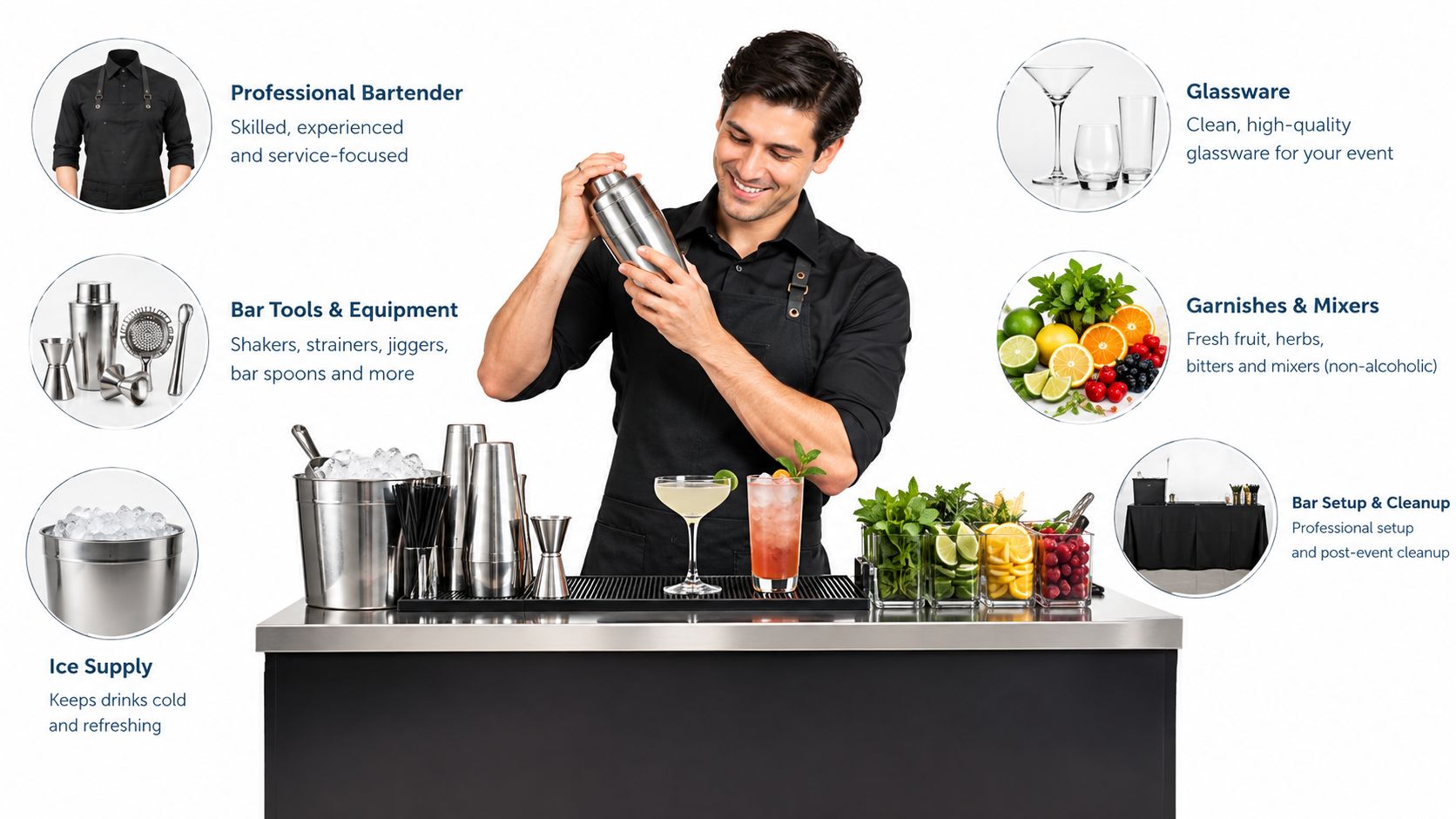
The service side covers the pieces most hosts don't want to source one by one:
Professional bartenders: Every booking includes at least one professional bartender
Bar setup: A styled portable bar based on the package and event needs
Menu planning: Signature cocktails, mocktails, and printed menus
Bar supplies: Mixers, ice, coolers, bar tools, plastic glassware, napkins, straws, and garnishes according to package
Event support: Setup, live service, and cleanup
That division keeps ownership clear. You stay in control of what alcohol is purchased, and the bar team handles the systems that turn ingredients into smooth service.
Why hosts often prefer this model
For corporate events, dry hire keeps budgeting easier to follow. Alcohol spend stays visible because you're purchasing it directly. Service spend stays visible because it's packaged separately.
That's useful when different people approve different parts of the event budget. One person may need to review staffing and rentals. Another may need to approve beverage purchasing. A dry-hire model keeps those conversations cleaner.
Practical rule: If your finance team wants purchase transparency and your event team wants less operational work, dry hire often fits both sides.
Our bookings start with a three-hour minimum, and the planning side matters just as much as the service window. Consultation is included, so the drink menu, shopping list, and setup can match the tone of the event instead of becoming an afterthought.
Where this works especially well
Dry-hire bartending is often a strong fit for:
Office celebrations where the company wants control over alcohol purchasing.
Brand launches that need custom cocktails, mocktails, and a polished visual setup.
Venue buyouts where there's no built-in bar infrastructure.
Client receptions where hosts want the room to feel polished without overcomplicating the menu.
One Orange County team might choose a concise cocktail menu with branded signage. Another might keep it simple with wine, beer, sparkling water, and one zero-proof signature drink. Both are dry-hire events. The difference is not the service model. It's the event objective.
How Many Bartenders Your Corporate Event Really Needs
The fastest way to under-plan a bar is to use one staffing rule for every event.
A beer-and-wine networking hour doesn't move like a holiday party with signature cocktails. A client mixer with staggered arrivals doesn't behave like a conference break where everyone walks to the bar at once. Staffing has to match both guest count and beverage complexity.
Start with service type, not just headcount
A long-standing event benchmark is about 1 bartender for every 50 to 75 guests, with one guide noting that corporate events are often slower-paced and may use about 1 bartender per 75 guests for a full bar and 1 per 100 guests for beer and wine only (event bartender ratio guidance).
More detailed operations guidance tightens those ratios based on what's being served:
Beer and wine service: around 1 bartender per 75 to 100 guests
Full bar service: around 1 bartender per 35 to 50 guests
Cocktail-heavy or high-volume events: around 1 bartender per 25 to 40 guests
That same guidance also recommends planning for the event's peak 20 to 30 minute surge, because that's where service problems usually happen, especially at arrival or just before and after major program moments (corporate bartender staffing ranges).
Corporate Bartender Staffing by Service Type
| Service Type | Recommended Ratio | When to Add Barback |
|---|---|---|
| Beer and wine only | 1 bartender per 75 to 100 guests | Add a barback when guest count rises or replenishment will be difficult |
| Full bar | 1 bartender per 35 to 50 guests | Add a barback when multiple spirits, garnishes, and faster restocking are needed |
| Cocktail-heavy or high-volume service | 1 bartender per 25 to 40 guests | Add a barback early if signatures, garnish prep, or repeated rushes are expected |
If you want a closer planning walkthrough, our guide on how many bartenders you need for an event breaks down common scenarios.
Why the first rush matters more than the average hour
Hosts often calculate drinks by the full event length, then assume the bar can spread demand evenly. Guests don't behave that way.
At many corporate receptions, the first wave hits all at once. People arrive, greet coworkers, and head straight to the bar before speeches or before dinner seating starts. If your staffing only works on paper across the whole evening, the guest experience can still feel slow.
The bar should be built for the busiest short window, not the calmest long stretch.
This is also why simpler menus often outperform larger ones. Two well-designed signatures and one mocktail usually move faster than a broad list with many builds, extra garnishes, and too many decision points.
Stations matter as much as bartenders
Throughput isn't only about labor. It's also about how many service lanes you create.
Event guidance recommends 2 bartenders plus 1 barback for cocktail receptions of 100 to 150 guests, 3 bartenders plus 1 to 2 barbacks for seated dinners of 150 to 250 guests, and multiple stations for larger events because lines grow quickly when one station serves too many people (bar station planning guidance).
That's a practical planning shift. Instead of asking only, “How many bartenders do we need?” ask, “How many guests will each station need to absorb during the rush?”
A single busy bar can slow down even with strong staff if everyone has to queue in the same place. Two smaller stations can keep the room feeling much more polished.
A quick way to sanity-check your plan
Before you finalize staffing, ask these three questions:
What are we serving? Beer and wine, full bar, or signature cocktails with garnish work?
When is the rush? Guest arrival, cocktail hour, keynote break, or post-program mingling?
What can run out first? Ice, glassware, bottled mixers, or garnish prep?
Those questions usually reveal whether your event needs one bartender, two bartenders, or added back-of-house support.
Service Expectations Compliance and Venue Logistics
A smooth corporate bar doesn't happen because the bartender is talented. It happens because the plan is coordinated before load-in starts.
That means your service expectations, venue rules, timeline, and bar placement all need to line up. When they don't, even a simple reception can feel scrambled.
What professional bar service should include on site
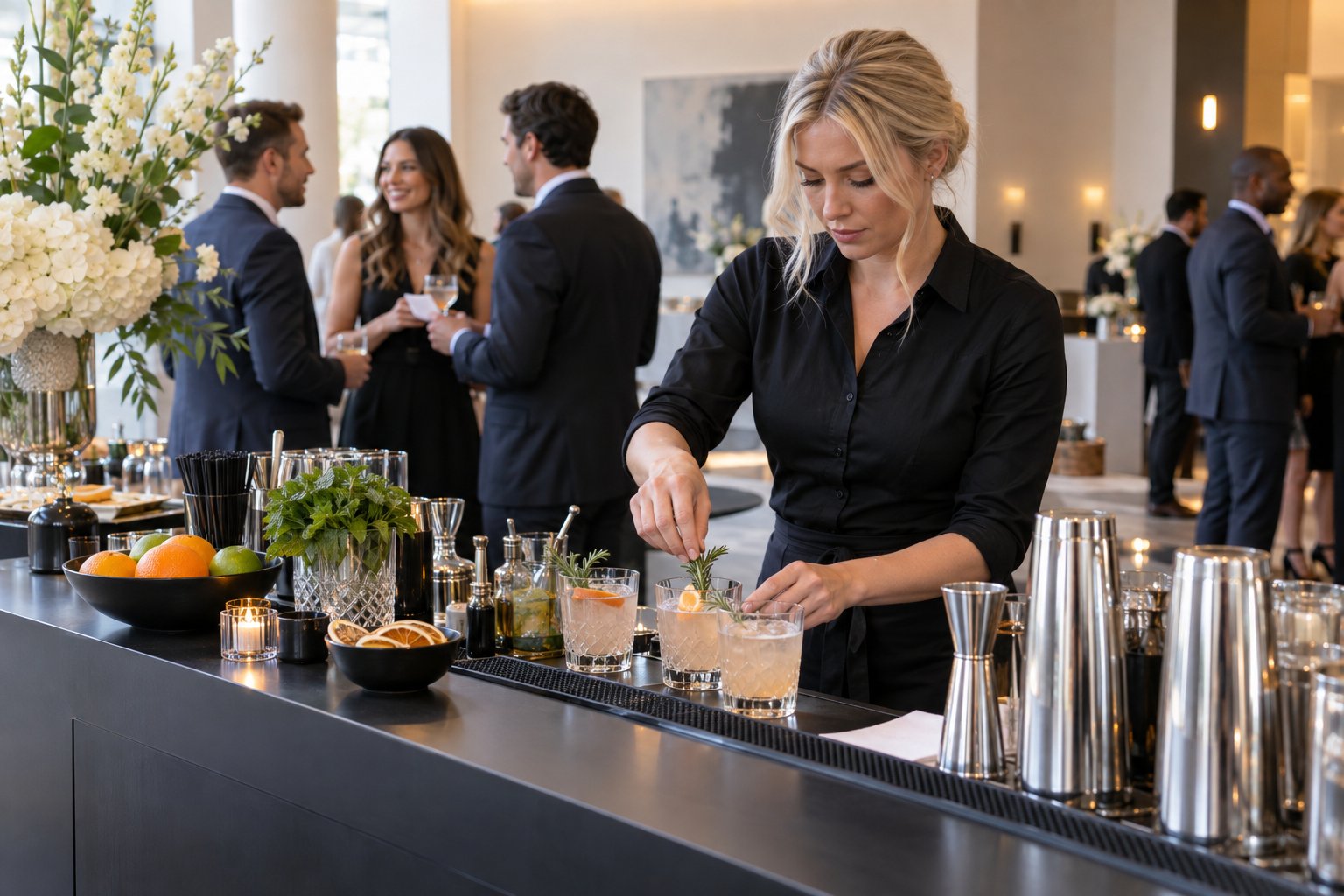
For a corporate host, the ideal outcome is simple. Guests know where to go, service starts on time, the bar stays clean, and the host isn't troubleshooting.
A strong pre-event checklist usually covers:
Bar placement: Enough space for guests to queue without blocking entries or high-traffic paths
Load-in timing: When the team can arrive, unload, and finish setup
Power and access: Whether the setup area needs nearby outlets or special access instructions
Parking and unloading: Where vendors can legally park and how equipment reaches the event space
Service timeline: Start time, pauses if needed, and final call expectations
House policies: Whether tip jars are allowed and what the venue requires for trash, breakdown, or exit timing
If you're comparing venue options or figuring out what level of support your event needs, our overview of bar service for events can help frame the decision.
Verification and responsible service
Corporate hosts also need to know what “professional service” means in practice.
It means checking IDs when appropriate, serving responsibly, and keeping the bar organized enough that service doesn't slip during busy moments. It also means understanding the difference between a celebratory atmosphere and an anything-goes atmosphere. For most office and client-facing events, guests want quality and ease, not a chaotic bar scene.
That's one reason many corporate planners now lean toward shorter menus, more visible water service, and strong zero-proof options. It supports the room without putting alcohol at the center of the event.
Guests remember when the bar felt easy to use. They also remember when it felt crowded, confusing, or ignored the tone of the event.
Venue coordination avoids last-minute friction
The venue may care about things your internal team hasn't thought about yet. Elevator access. Floor protection. Approved setup areas. End times. Disposal. Whether the bar can be placed outdoors. Whether a satellite station is needed near a patio or breakout area.
When those details are decided late, the host often becomes the middle person. That's exhausting during a corporate event because the host usually already has guest-facing responsibilities.
For events where tip jars aren't permitted, it also helps to account for service structure in advance. Our planning process includes the note that a 20% gratuity is added to the total when tip jars are not permitted.
A simple way to keep everyone aligned
One shared plan usually prevents most day-of issues. It doesn't need to be complicated. It just needs to confirm:
Bar location and access
Setup and breakdown window
Service hours
Beverage menu
Venue restrictions
Point person for questions on event day
That document often does more for service quality than adding another menu item.
Designing a Branded Beverage Program That Works for Everyone
At many company events, the most effective beverage menu isn't the biggest one. It's the clearest one.
A corporate bar now does more than offer standard pours. It can reinforce brand style, support the tone of a launch or client event, and make the room feel inclusive for guests who want alcohol-free options. Recent trend coverage points toward experiential bars, themed cocktail stations, premium no-alcohol drinks, lower-ABV serves, and visual presentation shaped by experience, health and visual impact (2026 beverage catering trends).
Fewer drinks can create a stronger impression
This surprises first-time planners. A shorter beverage program often feels more premium than a large, unfocused list.
Instead of offering every classic drink, many corporate hosts do better with:
One or two signature cocktails tied to the event mood, season, or brand palette
One strong mocktail that feels intentional, not like an afterthought
Beer and wine if the event needs familiar low-friction options
Water and soft drinks that are easy to spot and easy to reach
That structure reduces decision fatigue at the bar. It also speeds service because bartenders repeat cleaner builds.
Design for mixed drinking behavior
Corporate guests rarely behave like wedding guests or late-night party guests. Some will have one drink. Some will skip alcohol entirely. Some will want sparkling water the moment they arrive.
A widely used planning rule is to budget about 2 drinks per guest in the first hour and 1 drink per guest for each additional hour, and one calculator notes that a typical event may have around 70% of guests drinking alcohol.
That's one reason beverage forecasting should include visible non-alcoholic coverage. Independent planning guidance also notes that a 100-person, four-hour event can require about 400 total drinks, and one planning tool explicitly allocates 25% of beverage volume to water while separating beverage types instead of assuming everyone drinks the same mix (event beverage trend and planning notes).
Good branding isn't only visual
Brand alignment can show up in the details guests touch:
Printed menus: Clean names, clear ingredients, and a polished tabletop presence
Garnish choices: Citrus, herbs, dried fruit, or premium accents that fit the event style
Color and tone: Drinks that coordinate with a launch palette, holiday look, or seasonal theme
Ritual: A signature refreshment station or a first-drink moment that gives guests an easy starting point
A beverage program works when guests understand it in a glance and enjoy it without needing instructions.
One Orange County product launch might use a bright zero-proof spritz and a citrus-forward signature cocktail with a printed menu that matches brand colors. A year-end office party might use a simpler winter menu with one warm-weather-friendly mocktail, beer, wine, and infused water because the goal is fast service and broad appeal.
How to avoid overbuying while still looking generous
The mistake isn't always buying too little. Many corporate hosts buy too much because they plan as if every guest will drink alcohol steadily all night.
A better approach is to forecast from the actual event format. Shorter events, daytime events, professional networking settings, and guest lists with many drivers often need a more measured purchase plan. Adding a buffer still matters, but the menu should reflect how your guests are likely to participate.
Choosing the Right BeeHive Package and Planning Your Purchase
Once you know your event style, staffing level, and menu direction, package choice gets simpler. The goal isn't to pick the biggest package. It's to match the event's service needs and visual expectations without paying for extras you won't use.
For Orange County corporate hosts, that usually comes down to guest count, how custom the menu needs to be, and whether the event needs one clean bar setup or a more refined presentation.
Package comparison at a glance
Here's how our current package tiers align with typical event needs:
| Package | Starting Price | Best Fit | Included Highlights |
|---|---|---|---|
| Bronze | Starting from $749 | Small gatherings and lighter service | Mobile bar, 2 signature cocktails, 1 mocktail, 1 bartender, mixers, ice, coolers, shopping list, menu consultation, standard garnishes |
| Silver | Starting from $1,150 | Corporate events and fuller guest service | Large mobile bar, 3 signature cocktails, 1 mocktail, 2 bartenders, mixers, ice, coolers, shopping list, menu consultation, premium garnishes |
| Gold | Custom pricing | High-touch events with strong branding or luxury presentation | Custom-designed bar, 5 signature cocktails, 1 mocktail, 2 to 3 bartenders, mixers, ice, coolers, shopping list, fully custom menu, soft drinks and water, 1 signature refreshment, premium garnishes |
For a closer package breakdown, you can review our mobile bartending packages.
How to think about add-ons
Add-ons matter most when they solve a guest experience issue.
A few examples:
Extra service time: $100 per hour, per bartender when the event timeline grows
Soft drinks and water: $3 per guest, per beverage when you want non-alcoholic coverage built in
Signature Refreshment: Starting from $125 for one house-made option such as lemonade, infused water, iced tea, or a seasonal refreshment
Slushie Machine: Starting from $210 for an alcoholic or non-alcoholic signature slushie
These aren't just menu upgrades. They can reduce line pressure, give non-drinkers better options, and help the event feel complete during warm Southern California weather.
Planning your alcohol purchase without guessing
Because this is a dry-hire model, you'll purchase the alcohol. The easiest way to do that well is to work backward from the event format, not from a generic shopping list.
BeeHive creates a tailored shopping list based on your guest count, event length, menu, and service style, so you can purchase the right amount without relying on a one-size-fits-all formula.
BeeHive Mobile Bar provides the styled bar, professional bartenders, custom cocktails and menus, mixers, ice, garnishes, setup, service, cleanup, and the tailored shopping list.
Bringing It All Together for a Smooth Corporate Celebration
The bar at a company event does a lot of quiet work. It absorbs arrivals, supports conversation, gives guests an easy first interaction, and helps the host stay focused on the event instead of troubleshooting supplies or lines.
That's why the strongest corporate event bartender plan starts before the first bottle is chilled. It starts with the service model, a realistic staffing ratio, a layout built for the first rush, and a beverage program that welcomes both drinkers and non-drinkers.
For many Orange County events, the most polished result doesn't come from offering more. It comes from designing the bar with more intention. The right number of bartenders. The right number of stations. A concise menu. Clear non-alcoholic coverage. A purchase plan that avoids both shortages and overspending.
When those pieces line up, the room feels easier. Guests move better. The host breathes easier. And the event looks as professional in person as it did in the planning deck.
If you’re planning a corporate reception, office celebration, launch, or client event in Orange County or nearby Southern California, BeeHive Mobile Bar can create a polished bar plan around your guest count, venue, and event style. You purchase the alcohol from the tailored shopping list, and our professional bartenders handle the rest.