mobile bartending packages
Mobile Bartending Packages: A Complete Planning Guide
By BeeHive Mobile Bar ··19 min read
Updated
At a glance
- Choose a package for your menu, staffing needs, and service hours.
- Check equipment and supply inclusions in the written quote.
- Budget for alcohol and any agreed add-ons separately.
In this guide
Choose a bartending package that fits your menu, staffing needs, and service hours. Compare the written inclusions before deciding which starting price suits your event.
You've got the date, a guest count, and a budget that already has too many demands on it. Maybe you're planning a 120-person wedding reception and nearly chose the lowest quote, until you noticed it included one bartender, minimal cocktail service, and no clear plan for keeping the bar moving. That “saving” could leave guests standing in line while the wedding party is taking photos.
A package decision involves service hours, staffing and menu complexity. Check Cherry’s booking data reports a median total of about $750, a middle range of $450–$1,275 and a typical four-hour service window. These are cross-provider figures, not BeeHive package prices or included hours. Compare the actual written inclusions before using an industry figure as your budget.
Practical rule: Choose the tier that protects service speed first. Decorative upgrades come after staffing, ice, and a workable menu.
Choosing the Right Mobile Bartending Package for Your Event
Start with the guest experience, not the package name. Ask what guests will order, when they'll order it, and whether the bar needs to serve as a quick refreshment station or a featured part of the event.
Make the three decisions separately
Service hours determine how much labor and inventory you need. A four-hour reception with a bar open only during dinner is a different job from a six-hour celebration where guests arrive early and stay late. A longer window also means more ice management, replenishment, cleanup, and staff endurance.
Bartender headcount determines throughput. Beer and wine can move quickly because the bartender opens, pours, and hands over the drink. A shaken cocktail with fresh citrus, ice, garnish, and glassware takes more active steps. The guest count matters, but the number of steps per drink often matters more.
Cocktail ambition determines preparation and queue behavior. One signature cocktail can be batched and served efficiently. Several drinks requiring muddling, specialty garnishes, or separate spirit bases create a more demanding workstation.
A wedding reception, office mixer and private birthday may have the same guest count but different bar requirements. Compare the menu, service window and arrival pattern before choosing a package.
Use the mid-tier as your default test
Most events need more than basic pouring but less than a fully produced beverage installation. That's why the mid-tier usually makes sense for weddings, milestone birthdays, and corporate receptions. It gives you enough staffing and menu structure without paying for a custom bar experience that your guests may barely notice.
A simple test works well:
Write down the service window, including whether setup and breakdown happen outside guest-facing hours.
List the actual drink categories, such as beer, wine, two cocktails, mocktails, soft drinks, and water.
Identify the busiest moment, usually guest arrival, cocktail hour, or a post-dinner rush.
Reject any package that handles the easy parts but ignores that peak period.
The cheapest package is only cheaper if it delivers the service you need. If it forces you to add hours, another bartender, ice, glassware, or a shopping-list consultation later, the headline price tells you very little.
What a Mobile Bartending Package Actually Includes
A package is a bundle of operating parts, not a mysterious price label. Compare each proposal across the same building blocks, because two companies can use similar names while including very different levels of labor and equipment.
The five building blocks
The bar setup includes the physical mobile bar, ice tubs or coolers, work surfaces, and garnish trays. A standard bar works well when the venue already has a functional service area. A custom structure becomes useful when the bar is part of the visual design or the venue lacks a practical surface.
Bartender staffing covers the people, their service hours, and often their arrival and breakdown windows. Confirm whether setup time is included in the quoted labor. A bartender who arrives early to chill beverages, arrange tools, and prepare garnishes is doing productive work before the first guest orders.
Alcohol and supply responsibilities vary by service model. BeeHive is dry hire: the host purchases alcohol using a tailored shopping list. Bronze, Silver and Gold include the portable bar, professional bartending, mixers, ice, coolers, garnishes and the other listed package supplies. Bartender-only service includes professional bartending, bar tools, the shopping list, setup and cleanup; the host arranges the bar and other supplies unless the proposal adds them.
Bronze, Silver and Gold mobile-bar packages require a three-hour minimum. Bartender-only service starts at $350 for a two-hour minimum, with each additional hour at $75. It includes professional bartending, bar tools, a tailored shopping list, setup and cleanup. Confirm any additional equipment or supplies in your proposal.
The cocktail menu might be one signature drink, several curated cocktails, or a fully custom program. Menu breadth affects prep, storage, replenishment, and speed. Don't treat “more cocktails” as a free upgrade.
Operational extras include licensing confirmation, liability insurance, cleanup, waste removal, and venue coordination. These items rarely create a dramatic visual difference, but they prevent avoidable problems on event day.

Separate real value from brochure value
Staffing hours and alcohol supply usually drive the largest practical differences. More labor keeps service moving, while a larger or more specialized menu requires more purchasing and preparation. By contrast, a long list of minor supplies can sound generous without changing the guest experience.
Ask these questions before comparing totals:
Who buys the alcohol? The host, the bartender, or a licensed procurement partner?
What does “glassware included” mean? Real glass, premium disposable cups, or a limited quantity?
Is cleanup complete? Confirm whether the team removes waste, packs equipment, and leaves the bar area orderly.
What happens if the menu changes? A cocktail added late can affect mixers, ice, tools, prep, and staff time.
Bronze, Silver, and Gold tiers combine these ingredients at different levels. Judge the ingredients first. The label comes second.
Comparing Bronze, Silver, and Gold Package Tiers
A useful tier ladder should make trade-offs obvious. Bronze should solve basic service needs, Silver should handle the majority of polished private and corporate events, and Gold should earn its premium through capacity, customization, and coordination.
| Component | Bronze | Silver | Gold |
|---|---|---|---|
| Typical staffing | 1 professional bartender | 2 professional bartenders | 2+ professional bartenders |
| BeeHive starting price | Starts at $750 | Starts at $1,150 | Custom pricing |
| Alcohol model | Dry hire, client purchases alcohol using a tailored shopping list | Dry hire, client purchases alcohol using a tailored shopping list | Dry hire, client purchases alcohol using a tailored shopping list |
| Menu | 2 signature cocktails | 3 signature cocktails | 4 signature cocktails, plus a fully custom cocktail menu |
| Equipment and service | Mobile bar, mixers, ice and coolers, shopping list, menu consultation, standard garnishes | Large mobile bar, mixers, ice and coolers, shopping list, menu consultation, premium garnishes such as dried fruit and edible flowers | custom-styled mobile bar, mixers, ice and coolers, shopping list, soft drinks and water, 1 Refreshment Station, premium garnishes and presentation |
| Best fit, general guidance | Casual birthdays, office parties, backyard events | Weddings, milestone birthdays, corporate receptions | Large, formal, branded, or highly customized events |
Bronze keeps the job simple
At BeeHive, Bronze starts at $750 and includes a mobile bar, 2 signature cocktails, 1 bartender, mixers, ice and coolers, a tailored shopping list, menu consultation, and standard garnishes. The client purchases alcohol separately; confirm any optional extras in the proposal.
As general planning guidance, Bronze is best for up to 70 guests and works when guests mostly want familiar drinks and the bar doesn't need to become an entertainment feature. It starts to strain when more than roughly 70 guests arrive at once or when the menu becomes cocktail-heavy, because one professional bartender can't simultaneously build drinks, answer menu questions, restock ice, monitor supplies, and maintain a clean station without creating delays.
Silver is the workhorse
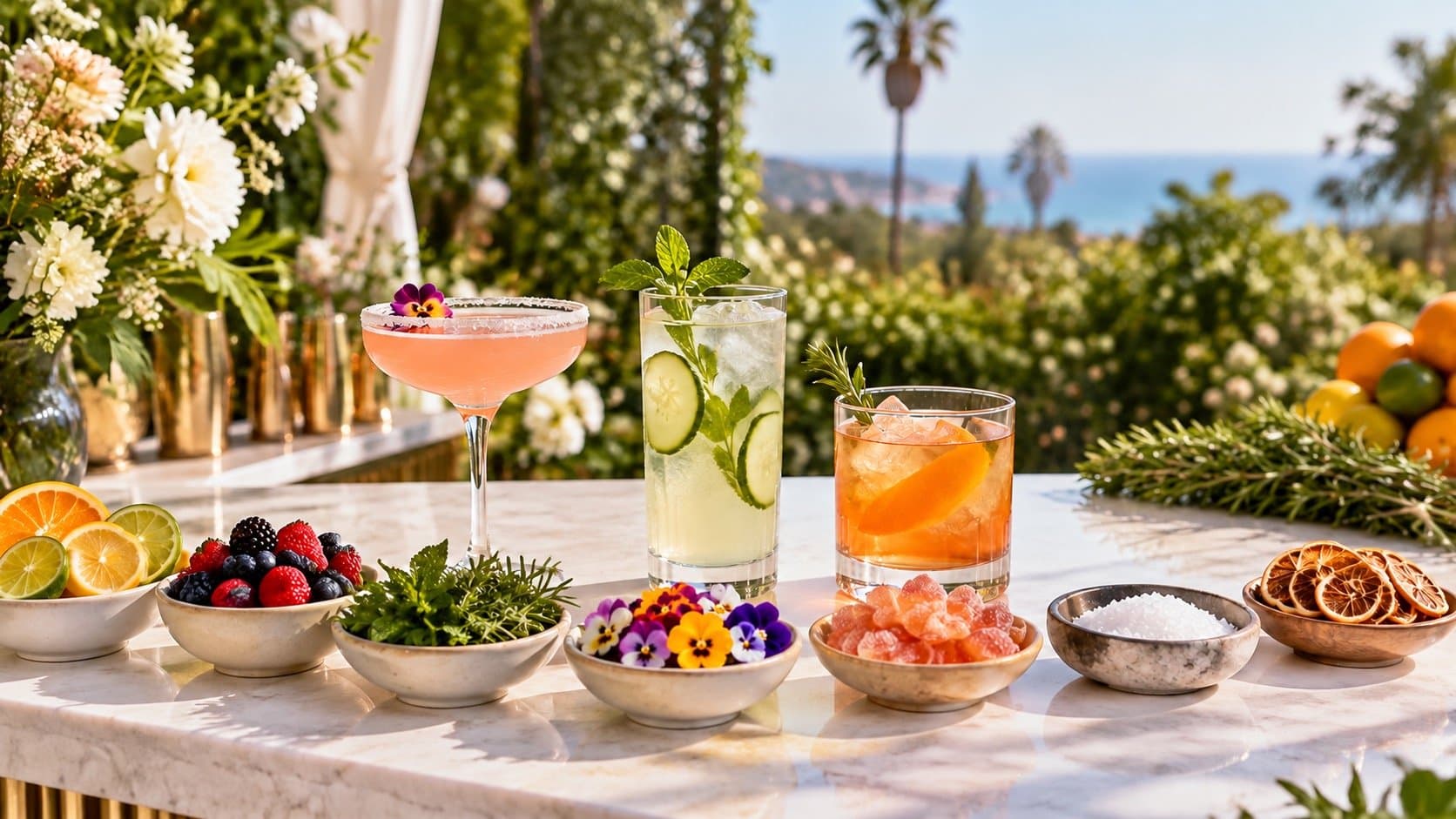
At BeeHive, Silver starts at $1,150 and includes a large mobile bar, 3 signature cocktails, 2 bartenders, mixers, ice and coolers, a tailored shopping list, menu consultation, and premium garnishes such as dried fruit and edible flowers. Soft drinks and water are not included.
As general planning guidance, Silver is the sensible choice for most weddings and reception-style events. Two bartenders provide a service buffer, while a curated cocktail menu gives the event personality without turning the bar into a laboratory.
This tier is less attractive for a short, casual gathering where guests only need simple service, and it can still strain during a long reception dominated by made-to-order cocktails if the bar setup or replenishment plan is inefficient.
Gold buys capacity and presentation
At BeeHive, Gold uses custom pricing and includes a custom-styled mobile bar, 4 signature cocktails, 2+ professional bartenders, mixers, ice and coolers, a tailored shopping list, a fully custom cocktail menu, soft drinks and water, 1 Refreshment Station, and premium garnishes and presentation. The client purchases alcohol separately; confirm any optional extras in the proposal.
Gold is best for 120+ guests and can also be discussed for a smaller celebration that calls for a custom-styled bar and menu. The right service depends on the guest count, service hours, menu and presentation requested; every event is quoted individually.
How Staffing Scales With Guest Count and Menu Complexity
Staffing is where package decisions become practical. Culinary Eye’s staffing guide gives starting benchmarks of one bartender per 50 guests for beer and wine and one per 35–40 for full cocktail service. These are general comparisons, not BeeHive package guarantees; preparation, menu complexity and guest flow matter.
Count tasks, not just people
A bartender's capacity includes more than taking orders. They must open bottles, measure spirits, shake or stir drinks, cut or place garnishes, restock ice, replenish mixers, manage glassware, and keep the station safe. If the bar sits far from storage, supply runs further reduce active service capacity.
| Guest Count | Beer and Wine Only | 1 to 2 Signature Cocktails | Full Craft Menu and Mocktails |
|---|---|---|---|
| Up to 50 | One bartender | One bartender, with prep | One bartender, if service is relaxed |
| 51 to 100 | One to two bartenders | Two bartenders | Two bartenders, possibly more for compressed service |
| 101 to 150 | Two bartenders | Two to three bartenders | Three or more bartenders, depending on layout |
| 150-plus | Two or more bartenders | Three or more bartenders | Custom staffing plan |
These ranges are planning guidance, not a substitute for a venue walk-through. A wide bar with organized ice and batched ingredients can outperform a cramped station with the same staff.
Use the threshold example
For 100 guests over four hours, beer and wine only can still run on one bartender if service is spread out and the venue layout is efficient. The same guest count and service window with two signature cocktails calls for two bartenders, because the order-to-handoff process contains more steps.
For alcohol purchasing, use the number of adults who may drink alcohol and the actual bar hours. BeeHive’s hourly setting plans one serving per drinking guest per hour; its hours-plus-one setting adds one further serving per drinking guest.
A four-hour event therefore produces four or five planned servings per drinking guest, depending on the setting. These are inventory assumptions, not consumption recommendations.
Plan water and alcohol-free drinks separately for everyone who needs them.
For a faster estimate of staffing needs, use this bartender staffing calculator, then adjust for cocktail steps, guest arrival patterns, and the physical bar layout.
Add-On Options That Change the Bottom Line
Add-ons should solve a real operational or hospitality problem. If an upgrade only makes the proposal look richer, keep the money in your budget.
Spend first on service capacity
Extra service hours are worth paying for when the event starts early, has a long dinner, or includes a late-night reception. At BeeHive, extra service hours for Bronze, Silver and Gold are $100 per hour per bartender. They're wasteful when the bar stays open after most guests have stopped ordering.
Additional bartenders are usually a better investment than decorative equipment when lines are likely. Add staff for high-volume arrival periods, cocktail-heavy menus, or venues where storage and replenishment are inconvenient.
Bar front and back upgrades matter when guests will see the workstation from several angles or when the event has a strong visual theme. They matter less when the bar sits against a wall or inside a service area.
Signature cocktail development earns its place at weddings and branded events, especially when the drink has a clear connection to the couple, company, or season. Don't commission several elaborate recipes if guests will mostly order beer and wine.
Spend selectively on product and presentation
Mocktail service is almost always worth it for daytime, family-friendly, corporate, and mixed-drinking events. A zero-proof option, water, soft drinks, and a thoughtful garnish give non-drinkers an actual hospitality experience rather than a token alternative. Alcohol calculators that use only a single “drinking guests” assumption can overstate spirits while leaving water and zero-proof beverages underplanned. (Mixed-drinking event calculator guidance)
At BeeHive, current add-ons include soft drinks and water at $3 per drink, a Refreshment Station from $125 including 4 gallons for up to 45 guests, and a Slushie Machine from $215 with 2 gallons of one flavor for up to 30 guests. Additional refreshment is $25 per gallon. Additional Slush is $45 per gallon. Soft drinks and water are included in Gold.
Extra ice, fresh juice, and garnishes are practical upgrades for cocktail menus. They're not ornamental. A shortage of ice or citrus can stop a high-demand drink even when the alcohol supply is sufficient.
A mobile bar trailer or vintage cart is worth considering when the venue lacks a usable bar surface and presentation is central. If the venue already has a functional bar, the trailer often adds visual cost without solving a service problem.

Travel deserves its own line item. Check Cherry reports that roughly 26% of its mobile-bar bookings include a travel charge, with a median billable distance of about 36 miles when charged. BeeHive travel fees depend on the event; confirm travel, parking and venue access in your proposal.
For a broader view of common package structures, compare the mobile bar pricing guide, then remove any add-on that doesn't support speed, inclusion, or the event's visual goal.
Translating a Package Into Real Alcohol Quantities
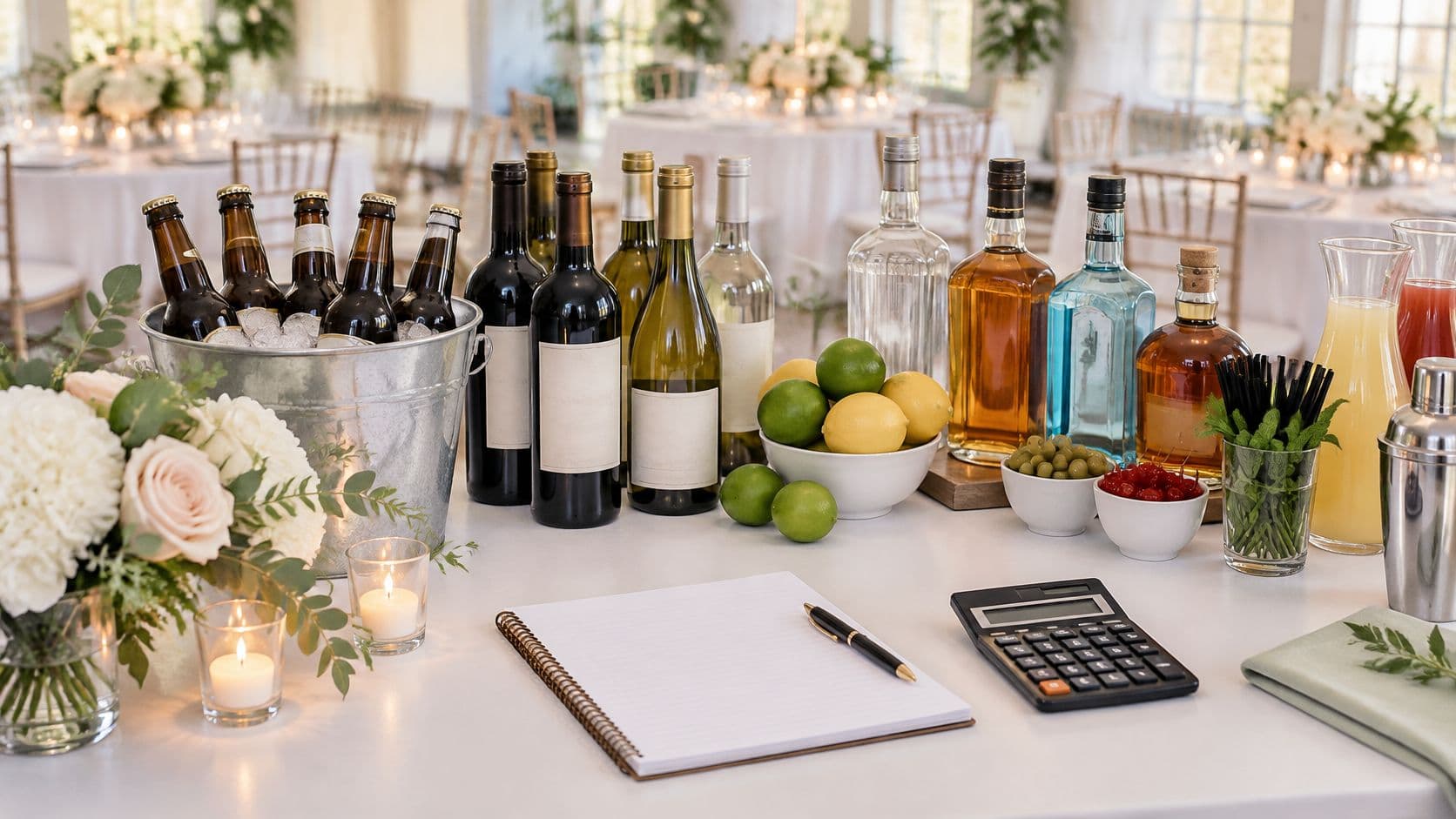
A confirmed package becomes useful only when it produces a shopping list. Start with the service window, guest count, drink mix, and crowd profile, then convert the result into beer, wine, spirits, mixers, ice, water, and zero-proof options.
Start with the drink baseline
Use the selected purchasing model consistently, then divide the resulting alcohol-serving total between beer, wine and cocktails. Keep any extra reserve separate and review the final list with your bartender.
A dry-hire plan should separate three questions:
How many total servings are likely?
What share will be beer, wine, spirits, and zero-proof drinks?
How many of those servings belong to each recipe?
Do not turn every serving into spirits. A mixed crowd can require more water, soft drinks, and mocktail ingredients than a basic calculator suggests. “More bar service” does not automatically mean “more alcohol.”
Convert recipes into purchasing units
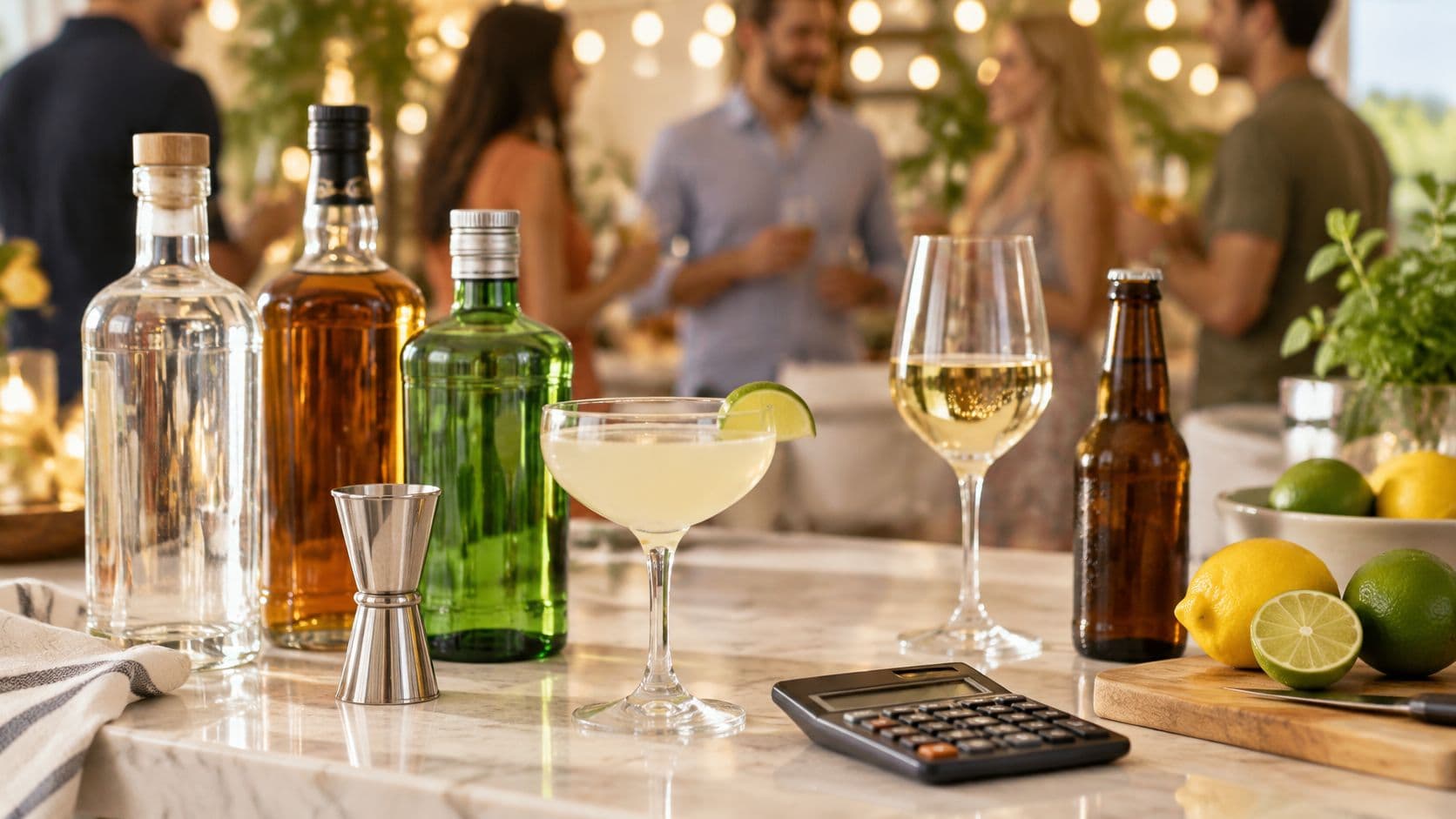
State container sizes and pour sizes explicitly. A 750 ml bottle holds about 25.4 US fluid ounces: approximately sixteen full 1.5 oz pours, or twelve full 2 oz pours, before spillage. A case of twelve 750 ml wine bottles supplies about sixty 5 oz glasses. Keg yields vary with keg size and pouring losses, so confirm the size rather than using one universal keg count.
BeeHive’s Silver package includes three signature cocktails, while Gold includes four and a fully custom cocktail menu. Divide the total spirit purchase among the actual recipes instead of treating each cocktail as a reason to buy a full separate bottle allowance.
For a four-hour wedding with 100 total guests, 70 guests who may drink alcohol and a 30% beer / 30% wine / 40% cocktail mix, BeeHive’s hours-plus-one setting plans for 350 alcoholic drinks. At 5 oz wine and 1.5 oz spirit pours, the alcohol shopping estimate is:
| Category | Planned servings | Purchase quantity |
|---|---|---|
| Beer | 105 individual servings | 5 packs of 24, or 120 beers purchased |
| Wine | 105 glasses at 5 oz | 21 bottles of 750 ml |
| Spirits | 140 cocktails at 1.5 oz of spirits each | 9 bottles of 750 ml total, divided by recipe |
This is an inventory example, not a consumption recommendation or a package quote. Mixers, ice, water, alcohol-free drinks, garnishes and a separate toast are excluded. Use the wedding alcohol calculator with your own details, then review the final list with the bar team. Bronze, Silver and Gold supply the non-alcohol items listed in their package; Gold includes soft drinks, water and a Refreshment Station.
Matching the Tier to the Event You Are Planning
Guest count alone is a weak buying signal. A 60-person corporate mixer and a 60-person wedding reception may need completely different mobile bartending packages because their service rhythm, menu, formality, and guest expectations differ.
Match the tier to the job
Bronze fits low-pressure gatherings. As general guidance, backyard birthdays, casual showers, and small office parties often need a staffed station, familiar beverages, and a simple featured menu. At BeeHive, Bronze includes 2 signature cocktails.
Silver fits the middle. As general guidance, weddings, milestone anniversaries, holiday parties, and polished corporate receptions benefit from two professional bartenders, a curated menu, and enough infrastructure to keep service consistent. At BeeHive, Silver includes 3 signature cocktails.
Gold fits high-demand or high-visibility events. As general guidance, black-tie fundraisers, multi-course rehearsal dinners, branded launches, and large receptions justify custom design when speed, presentation, and coordination all matter. At BeeHive, Gold includes 4 signature cocktails, a fully custom cocktail menu, and a custom-styled mobile bar.
Event type matters because the service timeline changes. A seated dinner concentrates orders around arrivals and meal transitions, while an open reception may spread demand more evenly. Confirm staffing against your actual schedule.
Avoid obvious mismatches
A Bronze package at a 200-guest wedding will create long lines and force one professional bartender to manage a service load the tier wasn't designed for. A Gold package at a 40-person housewarming may produce an impressive setup, but it can inflate the budget without improving the drinks or the interaction.
Corporate planners should prioritize speed, professional presentation, and inclusive non-alcoholic service. Wedding planners should weigh cocktail personalization, glassware, photographs, and the bar's role in the reception design. Festival and public-event planners need volume planning, queue control, replenishment routes, and a staffing plan built around throughput.
Pick the tier that matches the event's ambition. A lower tier is not automatically efficient, and a higher tier is not automatically more hospitable.
Final Checklist Before You Book a Package
Before signing, compare the proposal against the actual event plan. A quote is incomplete if it gives you a total without defining labor, inventory responsibility, and the conditions that can change the total.
Confirm the guest count: Add a 10% planning buffer for no-shows and plus-ones, as specified in the booking checklist you're using.
Lock service hours: Record guest-facing service, setup, breakdown, venue access, and last call separately.
Finalize the drink menu: Name each cocktail, mocktail, beer, wine category, and any soft drink, water, or Refreshment Station option.
Review every cost: Ask whether gratuity, insurance, travel, parking, ice, soft drinks, water, and overtime are included or added later.
Assign alcohol responsibility: Confirm whether the operator supplies a shopping list, procures the alcohol, or accepts a curated order.
Verify licensing and insurance: Ask what the venue and local rules require, and request documentation where appropriate.
Ask about staffing backups: Find out what happens if a bartender calls out or the guest count changes.
Clarify unopened bottles: Establish who takes remaining alcohol home and how inventory is handled.
Get weather and cancellation terms in writing: Outdoor events need clear rain-date, postponement, and cancellation language.

If any answer is vague, pause before paying a deposit. Request a revised quote that names the tier, staffing, service window, menu, alcohol plan, add-ons, travel terms, and cancellation policy in plain language.
BeeHive Mobile Bar provides dry-hire mobile bartending with certified bartenders, portable bar setups, menu planning, shopping-list support, and service scaled to the event. Review the available options and request a plan through BeeHive Mobile Bar before you commit to a package that doesn't match your guest count or cocktail goals.