grand opening ideas
Grand Opening Event Ideas: Cocktail and Mocktail Welcomes
Grand opening event ideas for retail stores: a preview reception, timed welcome, cocktail and mocktail menu, and a run-of-show with clear roles.
By BeeHive Mobile Bar ··18 min read
Updated
In this guide
You've signed the lease, the fixtures are in, and the landlord wants a date for the ribbon cutting. Then someone asks the question that stalls the meeting. Are we doing drinks?
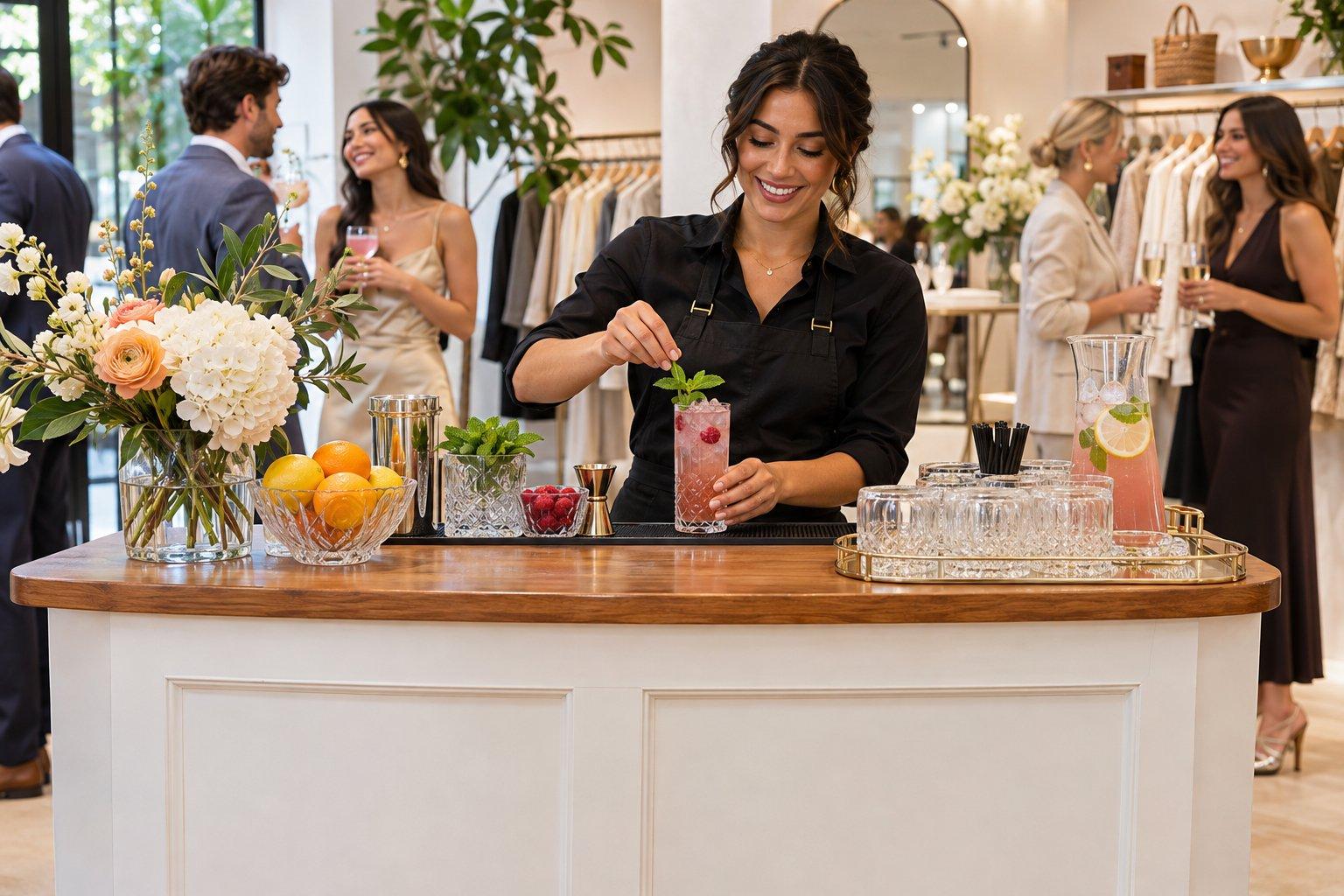
A grand opening is a store's first handshake with its neighborhood. A bar is one of the few elements that gives people a reason to stand still, talk to staff and stay five minutes longer than they planned.
It's also the element most likely to go sideways, because a badly placed bar blocks the entrance, a menu printed too late can't be fixed, and a store that advertises cocktails before checking its venue's alcohol rules has to walk it back in public.
The openings that look effortless run on one timed welcome, two interactive stations and a short drinks menu. The ones that look chaotic tried eight things and staffed none of them properly.
Six Grand Opening Event Ideas at a Glance
A strong grand opening pairs one timed welcome with one or two interactive stations. Add a fourth and fifth element and you split the staff you need for the first two.
The six ideas below are the ones a retail team can plan around. For each, the guest action is what the event is built to produce, so your team can count it afterward instead of arguing about whether the day felt busy.
| Event idea | Guest action | Best timing | Where the bar fits |
|---|---|---|---|
| Preview reception for invited guests | Sign in, sample and join the list | Evening before public doors open | Welcome bar at the entrance, off the main path |
| Timed welcome moment | Gather for a ribbon cutting or speech | Opening minute | Toast served from glasses prepared in advance |
| Product demonstration with a drink pairing | Try the product and the drink together | Mid-morning or afternoon | Bar beside the demonstration area |
| Mocktail-led tasting | Taste flavors from a new collection | Any opening session | Alcohol-free station with clear labels |
| Opening-week offer on the printed menu | Redeem the offer by QR code or at checkout | Full opening week | Menu card placed at the bar |
| Customer appreciation hour | Meet staff and book a return visit | Second day or weekend | Compact bar near the exit, away from checkout lines |
Read the last column as a floor-plan decision, not decoration. A bar at the entrance works only if it sits off the main path, because a line of thirsty guests in the doorway stops new shoppers from walking in at all. A bar near the exit works for an appreciation hour because guests collect a drink on their way out rather than doubling back through checkout lines.
In-person events have recovered enough to justify the effort. An industry summary of experiential marketing statistics reported that attendance at in-person events was 34% higher in spring 2023 than in spring 2022 and 23% higher than in spring 2019, and that 80% of people preferred in-person events over virtual formats. The interaction itself shifts opinion. A 2025 compilation citing Freeman and EventTrack reported that 77% of consumers said interacting with a brand at a live event increased their trust, 66% said they were more likely to purchase after interacting with a brand at an event, and free samples ranked as the leading engagement incentive at 60%, ahead of branded merchandise at 57% and discounts or special offers at 52% (experiential event marketing statistics).
That ranking is the argument for putting a drink in someone's hand rather than describing it on a sign. A tasting is a sample. A mocktail named after a new collection is a sample with a story attached.
Choose two or three ideas from the table based on floor space, expected guest count and the single goal you care about most. November and December traffic fills a store fast, and holiday shoppers bring coats, bags and gift-wrapping detours, so pick fewer ideas that are easy to staff. Before you advertise any of them, confirm the approvals behind each one: whether the venue and landlord allow alcohol service on the floor, and whether a timed welcome can legally pause foot traffic at the entrance. Set one measurable goal per idea before doors open, because attendance on its own won't tell you whether any of it worked.
How Dry-Hire Bar Service Works for a Store Opening
Hiring a dry-hire bar is like hiring a catering crew to cook in your own kitchen. You buy the groceries and provide the kitchen. They bring the skill, the equipment and the timing.
BeeHive Mobile Bar is a dry-hire bartending service. Clients purchase and provide all alcohol. We provide professional bartending, a personalized shopping list, menu planning, setup and breakdown, and staffing suited to the event and guest count.
Who supplies what
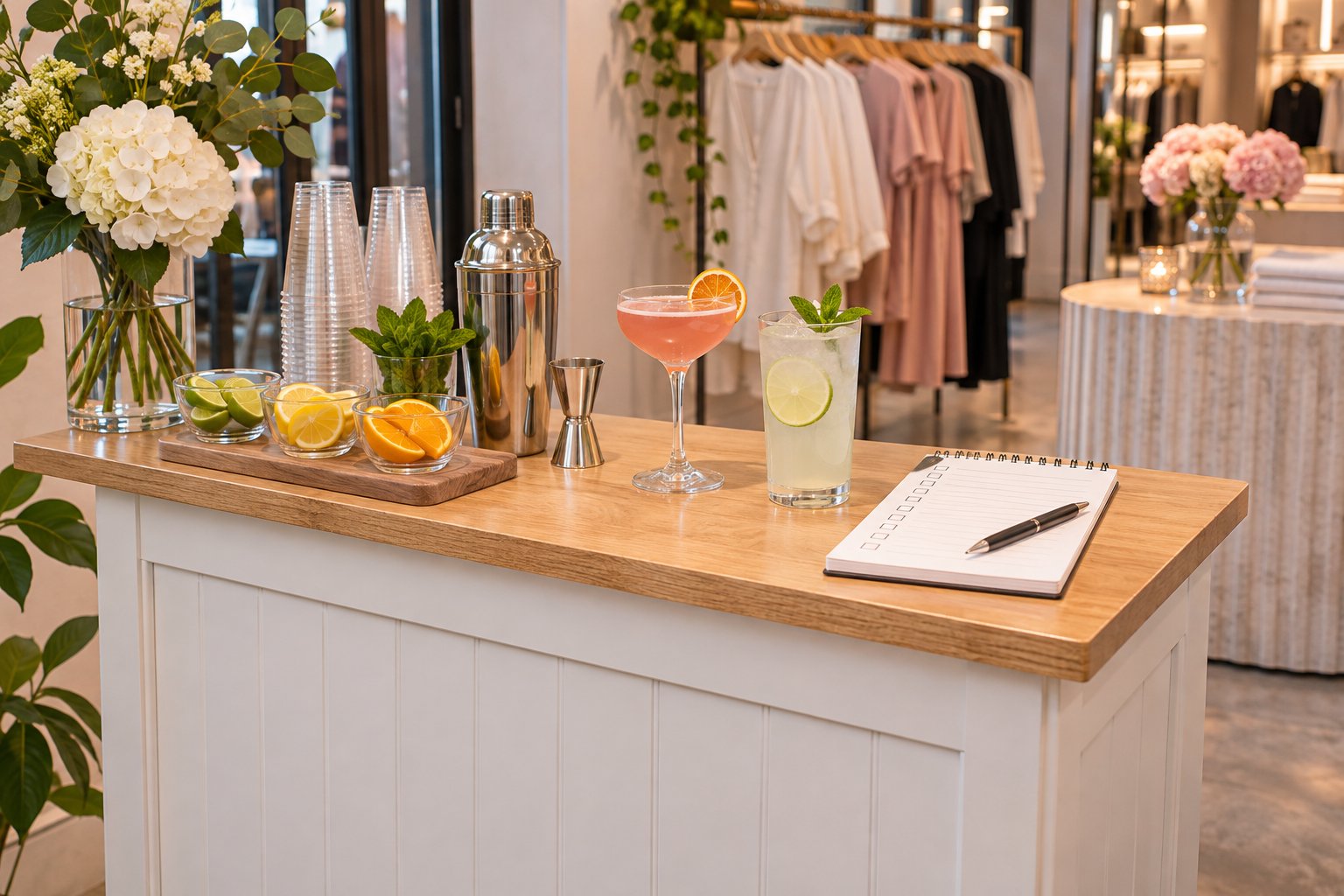
Split the work into three buckets before you sign anything, because the gaps show up at the worst possible moment.
The bar team handles service, pacing, the bar area itself, and the cleanup of that area at the end of the night.
The store handles venue access, the alcohol purchase, ice and drinkware where they aren't in the package, signage, and the staff working check-in.
Both sides sign off on the menu, the timeline and an emergency contact list that includes someone who can make a decision on the day.
The failure mode is predictable. A store assumes the bar provider brings the alcohol, the provider assumes the store has it, and the gap appears at 5:40 pm with guests already in the room.
If you haven't worked with this model before, our guide to how dry-hire mobile bar service works covers the handoffs in detail. The booking itself runs in four steps: Start the Conversation, Customize Your Bar, Confirm & Prepare, and Enjoy the Celebration. The customize step is where you choose the menu, the bar setup and the event details, so bring your floor plan to that conversation rather than after it.
Three questions to answer before you book. Who buys the alcohol, and when does it arrive? Who signs for the venue and holds the paperwork? And who is responsible for guest behavior at the bar if someone has had enough? Answer those in writing and the rest of the planning gets easier.
Permits, Alcohol Rules and Venue Checks to Confirm
A store opening advertised to shoppers may have different alcohol-service requirements from a private event. That distinction shapes the bar plan. It affects where drinks can be served, who may buy alcohol, what the venue must approve, and how close the bar can sit to entry, checkout or product displays.
For an opening advertised to the public, confirm with California ABC and the venue whether alcohol service is allowed and what licenses or approvals apply before advertising drinks. BeeHive provides dry-hire bartending; the host purchases and provides the alcohol. See the ABC private party rules for general information about private events.
Practical rule: confirm the event's access, drink-service plan and venue requirements before anyone designs a menu. Those answers inform the approvals to check, the shopping list and the service model.
If California ABC advises that a license may be relevant, check license eligibility and application requirements in the Form ABC-221 instructions and confirm the applicable requirements with ABC.
For a retail opening, treat the bar as part of guest flow. A line that forms at the doorway can block browsers before they reach merchandise. A tasting table placed beside checkout can slow conversion. The approvals and the floor plan have to match, so confirm requirements before advertising free drinks or a signature cocktail.
The five checks to run before anything is printed
Is the event invitation-only? If the public is invited, don't assume the private-party exemption applies.
Is alcohol complimentary, and who buys it? Free drinks served by a host sit differently from a cash bar.
Does the venue allow host-provided alcohol, or does it require a licensed vendor?
Does the venue need written authorization or a license application before the event?
Which other permits apply to food sampling, outdoor cooking, tents, displays or temporary structures?
For events at OC Parks facilities, OC Parks generally requires permit applications 30 days before the event; when using vendors on its verified-insurance list, the minimum is 14 days. Confirm the applicable deadline directly with OC Parks. Events on county property or rights-of-way may require an Encroachment Permit, and events involving food preparation or service may need review from the Orange County Health Care Agency (county special events permitting). For cooking, tents, or temporary structures, check the permit requirements and deadlines with the venue and the relevant local fire authority.
Other cities, private venues and county departments set their own deadlines. Start these checks before the menu is printed, because a change from complimentary pours to a paid bar can change the permit path, the staffing model and the way the bar sits on the floor. If the approval is uncertain, keep the advertised details general until the venue and city requirements are clear.
Opening-Day Run-of-Show With Responsibilities
A run-of-show is a timeline with one named owner for every block. Without owners, it's a wish list that dissolves the moment the first guest walks in.
| Time block | Activity | Bar responsibility | Owner |
|---|---|---|---|
| 2 hours before doors | Setup, ice check and bar staging | Bar set, mixers and garnishes staged, ice kept separate | Bar lead with store manager |
| 30 minutes before doors | Team briefing and menu sign-off | Printed menu displayed, alcohol-free labels checked | Store manager |
| First 30 minutes of doors | Welcome and first drinks | Mocktail and signature drink served with steady pacing | Bartender and greeter |
| Timed welcome moment | Ribbon cutting or speech | Toast poured from glasses prepared in advance | Event lead |
| Mid-event | Demonstrations and shopping | Restock from the cooler, keep queue lane clear | Bartender and inventory lead |
| Last 30 minutes | Wind-down | Stop alcohol service at the agreed time, offer water and refreshments | Bartender |
| After close | Breakdown and count | Bar team clears its area; host handles any remaining alcohol | Bar lead and store team |
These sample times are measured from the public opening. If you hold a preview reception the evening before, plan a separate schedule for it.
Build the sheet in five steps
Mark the fixed moments first. Doors, the ribbon cutting, any speech, and the time the store wants the floor clear.
Work backward from each moment to set setup time. A bar that needs two hours to stage doesn't get staged in forty minutes because the caterer was late.
Assign one named owner to every block. A role isn't an owner. A person is.
Confirm the final alcohol-service time against venue rules, not against the store's closing time. Those are different constraints.
Share the sheet with both teams two days out, so the store manager and the bar lead are working from the same page.
Event time and booked service time aren't the same thing. Bronze, Silver and Gold packages have a three-hour service minimum; bartender-only service has a two-hour minimum. The proposal states the hours you've booked. Read those hours before you promise guests a full evening of service.
Count four ratios, not one
Measurement belongs in the run-of-show, not in a conversation afterward. Event Marketer's experiential-measurement research found that 81% of consumer brands track total visitors or attendees, while 47% tracked engagement in specific on-site demonstrations or digital elements (experiential measurement benchmarking report). Reach alone doesn't tell you whether the opening worked.
Track four ratios through the day: passersby to stops, stops to served guests, served guests to leads, and leads to redemptions. Each one points at a different bottleneck. A weak first ratio is a visibility problem. A weak second is queue design or service speed. A weak third is the offer, not the drink.
If the expected crowd needs a security presence at the door or someone managing the queue, the ABCO Security event hiring guide sets out what to brief them on before the day. Sort the counts out after close, when you can compare them against the goals you set, not during the rush when the numbers are still moving.
Build a Short Cocktail and Mocktail Menu
A grand opening bar should support the store's goal: keep guests moving, give them a reason to linger at the right moment, and make the product or brand easy to remember. Three drink paths are usually enough.
Offer one signature cocktail, one zero-proof version built on the same flavor profile, and one seasonal refreshment such as lemonade, infused water, iced tea or another seasonal option. That gives guests a real choice without turning the bar into a queue.
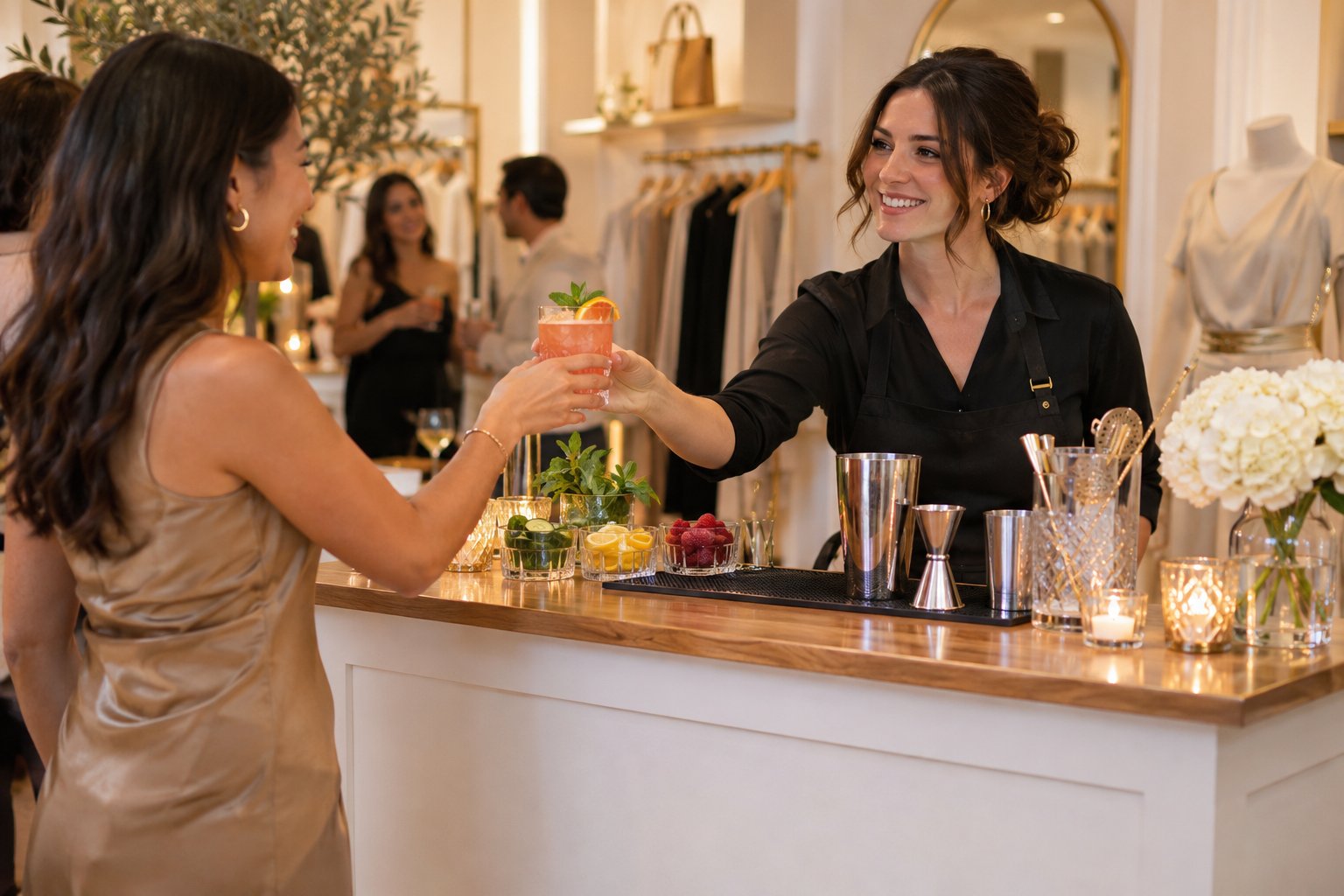
Name each drink after a product, a department or a store element. A menu that reads like a brand extension supports the store.
A menu of generic classics reads like a rental. For retail events and brand launches, BeeHive can create a custom drink menu that complements the brand and occasion, then print it on the menu included with the package.
BeeHive also served a Peach Cloud mocktail at a Fashion Island event for J. Pritchard during Fashion Week, which shows how one named zero-proof drink can fit a retail setting without expanding the bar.
Use choice architecture at the bar
Personalization does not need to mean a long conversation per guest. A Bizzabo survey of more than 1,500 event organizers and attendees reported that 39% of organizers considered on-site personalized activations the most impactful personalization tactic (Bizzabo benchmarking report). The practical version is a short decision tree. Guests pick a flavor profile, alcoholic or alcohol-free, and a garnish style. Staff build each drink from a standardized recipe card, which keeps decisions quick and the line short.
Pre-batch base mixes away from the guest-facing bar so the bartender is not measuring syrups in front of an audience. Keep ice for drinks in a separate bin from ice used to chill bottles. If you are weighing layouts before you commit to a format, it helps to compare bar drink menu layouts so the printed card and the physical bar agree with each other.
Run the quantities from stated assumptions
Say 120 expected attendees, a two-hour service window, an assumed 1.5 drinks per guest per hour, and an assumed split of 60% cocktail and 40% alcohol-free. That gives 360 drinks (120 x 1.5 x 2), of which about 216 are cocktails and 144 are alcohol-free. Change any assumption and recalculate. These are planning estimates, not guarantees or drinking recommendations, and mixers, water and other alcohol-free drinks belong on separate lines. The two-hour window is an illustration; BeeHive's Bronze, Silver and Gold packages have a three-hour service minimum. Confirm appropriate staffing for 120 expected attendees in the proposal.
Menu planning belongs in the customization step, alongside the bar setup and event details. Every package includes a custom printed menu, and bartender-only service does not automatically include one, so confirm which service you are booking in the proposal. For more starting points, browse cocktail menu examples for retail events.
Bar Placement and Guest Flow in a Holiday Store
The most common placement mistake is putting the bar at the back of the store. Guests walk past the product to reach it, then carry a drink back out through the floor, and the bar becomes a destination instead of a welcome.
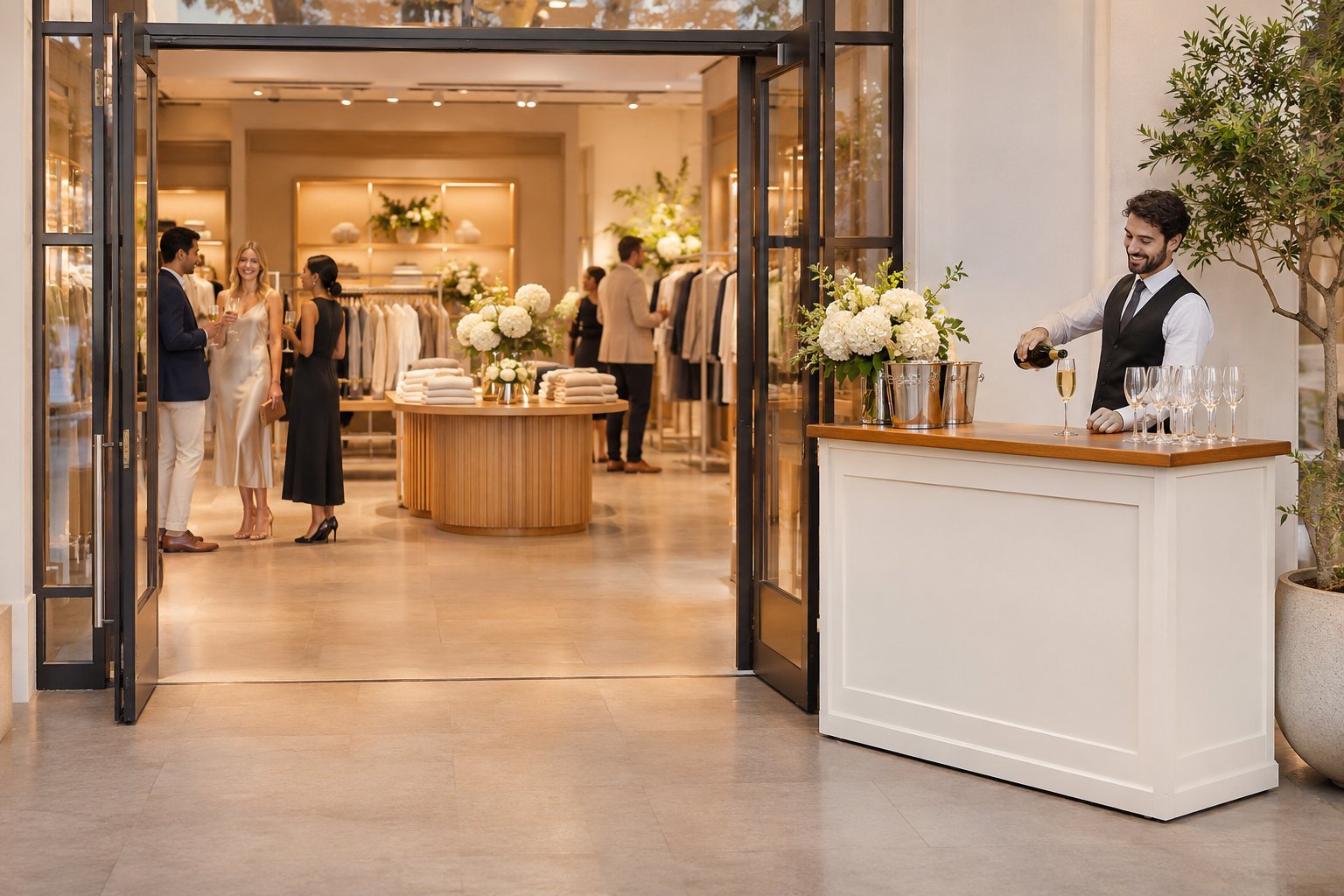
Three placements work better. A welcome point just inside the entrance that doesn't block the main path. A bar beside the demonstration area, so the drink and the product are experienced together. Or a compact station near an exit, positioned away from checkout and fitting rooms so it never competes with the till. A smaller mobile bartending cart often solves an entrance that's too tight for a full bar footprint.
In November and December, indoor flow changes. Holiday shoppers arrive with coats and bags, gift wrapping creates a second queue, and a bar that works in June can become a pinch point in December. Plan a marked queue lane that keeps the doorway clear, and confirm aisle widths and exit clearances against your building and fire-safety requirements rather than estimating them.
Treat accessibility as part of the layout
A visually impressive cocktail station can exclude guests if the mocktails and water aren't as visible and as easy to reach as the cocktails. Among planners, 42% now consider accessibility very important when choosing a venue, 45% consider it somewhat important, and 74% say they're prioritizing accessibility more than before, according to Cvent's event statistics.
Work through a short checklist with the store team: accessible entrances and restrooms, unobstructed service areas, seating, clear signage, captioned announcements, a quieter low-sensory period, alcohol-free drinks at the same visibility as the bar, and a way for guests to request accommodations when they register.
Walk the layout at least two weeks before opening and mark four routes on the floor plan: the queue lane, the service point, the accessible route and the cleanup route. A bar that clears the aisle on paper can still block a wheelchair turn in practice.
Confirm Your Bar Plan and Request a Quote
Send the quote request with the details that change the price: date, estimated guest count, service hours, venue location and the add-ons you are considering. BeeHive quotes each event individually based on guest count, service hours and add-ons.
A rough headcount is useful, but the proposal will be sharper once you know whether the opening is a storewide reception, a VIP preview or a short media window with a defined guest list.
The booking process has four steps: Start the Conversation, Customize Your Bar, Confirm & Prepare, and Enjoy the Celebration. In the customize step, choose the menu, bar setup and event details.
That is the point to align the bar with the store's goal. If the goal is to move shoppers through the door, keep the bar compact and secondary.
If the goal is a brand launch with a press moment, a styled bar and a short signature menu may deserve more floor space.
Packages should be matched to the crowd and service window. Bronze starts at $750 and covers up to 70 guests.
Silver starts at $1,150 and covers up to 120 guests. Gold is custom quoted and is recommended for 120+ guests.
Bronze, Silver and Gold have a three-hour service minimum; bartender-only service has a two-hour minimum. Full packages include the portable bar, mixers, ice, garnishes and serving supplies, along with a custom printed menu, setup and breakdown.
Bronze, Silver and Gold packages include plastic glassware, napkins and straws. Bartender-only service does not automatically include the portable bar, mixers, ice, garnishes, serving supplies or a printed menu.
Bar staffing is set to fit the event and the guest count, so the quote should confirm how many bartenders the plan needs.
For retail events and brand launches, ask for a custom drink menu that complements the brand and the occasion. Clients can also ask about custom add-ons beyond the listed add-ons.
The Gold package includes menu planning, a custom printed menu and an alcohol shopping list. It also includes four signature cocktails, 2 or more professional bartenders, soft drinks, water, a refreshment station, bar tools, mixers, ice, coolers, premium garnishes and presentation.
If alcohol service is lighter than expected, a self-serve Refreshment Station may be a better fit for part of the plan. It starts at $125 and includes 4 gallons of house-made lemonade, infused water, iced tea or a seasonal refreshment. The 45-guest figure is a planning estimate based on portion size and consumption, not guaranteed capacity. Additional gallons cost $25 each.
Reserve early when the opening lands on a weekend or holiday. Weekends and holidays book quickly, so early inquiries are recommended. Once the quote works, a signed contract and a 25% booking deposit are required to reserve the event date. Tips are optional, and tip jars require client and venue approval.
Ask for the proposal in writing before approving the plan. Confirm the quoted guest range, service hours, staffing, included supplies, printed menu, add-ons and payment terms. Then send the date, guest count, venue details and any brand-specific drink direction through BeeHive Mobile Bar. The proposal should give the store a clear bar plan without turning the opening into a bar buildout.