tip wedding bartender
How Much to Tip a Wedding Bartender: Examples and Etiquette
Decide how much to tip a wedding bartender, compare flat and percentage examples, check invoice charges and confirm tip-jar approval.
By BeeHive Mobile Bar ··9 min read
Updated
In this guide
At BeeHive, tips are optional and appreciated. If you would like to leave one, choose an amount that fits your budget and the service you received. Start by checking your agreement for any included gratuity, then decide whether a flat amount per bartender or a percentage of the service fee is easier for you.
Published wedding tipping guides suggest different amounts because they use different bases. A liquor bill, a full catering invoice and a bartender’s service fee are not interchangeable. For a dry-hire event, keep the alcohol you buy separately out of a service-fee calculation.
This guide explains how much to tip a wedding bartender with simple examples, invoice checks and a clear handoff plan for Orange County weddings.
Typical Tip Amounts for Wedding Bartenders
The wedding vendor tipping cheat sheet compares guidance that ranges from $20–$50 per bartender to percentage-based tips. These are outside etiquette suggestions, not BeeHive fees or expectations. There is no single amount that fits every reception.
Choose one approach as your starting point. You do not need to add a flat tip on top of a percentage tip.
Tip methods for wedding bartenders
| Approach | Illustrative choice | Total |
|---|---|---|
| Flat amount per bartender | $35 each for two bartenders | $70 total |
| Percentage of a chosen service subtotal | 15% of a hypothetical $1,000 subtotal | $150 total; $75 each if evenly divided between two bartenders |
| No additional tip | You choose not to leave an optional tip | $0 additional |
Practical rule: choose a starting amount before the wedding, then adjust it afterward if you wish. You do not need to combine flat and percentage methods.
Check Service Charges and Gratuity on Your Invoice
Read your agreement and invoice before setting aside a tip. A charge’s label alone does not tell you whether it is distributed to the bartenders.
The IRS distinguishes voluntary tips from required service charges. That tax distinction does not tell you how a particular vendor distributes a charge; ask the provider directly.
That distinction matters because a venue, caterer, planner or bar provider may already carry an administrative fee, a staffing fee or a gratuity line in the proposal. Read for the words "service charge," "administrative fee," "mandatory gratuity" and "included gratuity," then ask a direct question: who receives this money?
Invoice terms and what they mean for a tip
| Invoice term | What it usually means | What to do |
|---|---|---|
| Mandatory gratuity or service charge | Required amount set by the contract | Confirm who receives it; an extra tip is still optional |
| Included gratuity paid to bartenders | A gratuity is identified as going to the bar team | Reduce or skip the optional tip |
| Administrative or overhead fee | Business charge, not automatically staff pay | Ask the vendor; don't assume it reaches bartenders |
| No gratuity line | No separate gratuity is shown; this does not mean staff are unpaid | Leave an additional tip only if you choose |
If gratuity is already included and paid to the team, you can leave it there. An additional amount remains your choice.
Read each vendor’s own agreement rather than applying one supplier’s terms to everyone. For example, Smartpicsuk’s hire terms concern that supplier’s services, not BeeHive’s gratuity policy.
For what the service fee itself should look like, our breakdown of wedding bartender cost walks through package and hourly structures. Whatever you settle on, calculate any percentage only against the bartending or package fee the contract identifies.
Calculate a Flat or Percentage Tip Step by Step
The arithmetic is simple once the base number is right. Work through these five steps in order and write down each answer.
Confirm the subtotal in writing. Use the bartending fee or the package price the contract names, not the retail value of alcohol you bought separately. Ask the vendor to point to the line.
Choose one method. Flat per bartender or a percentage of the subtotal. Combining both increases the total and may count the same intended tip twice.
Run the total. With a hypothetical $1,000 bar-service subtotal and no gratuity, 15% produces a $150 total tip.
Divide it among the bartenders. That $150 split between two people is $75 each, unless the contract specifies another distribution.
Record the worksheet line. Method, total, recipient, handoff time. All four settled before the day.
For a flat-tip example, suppose you choose $35 for each of two bartenders. The optional gratuity is $70 total. This is a tip calculation, not the price of hiring the bartenders.
Write the plan down before wedding week, while there's still room to change it.
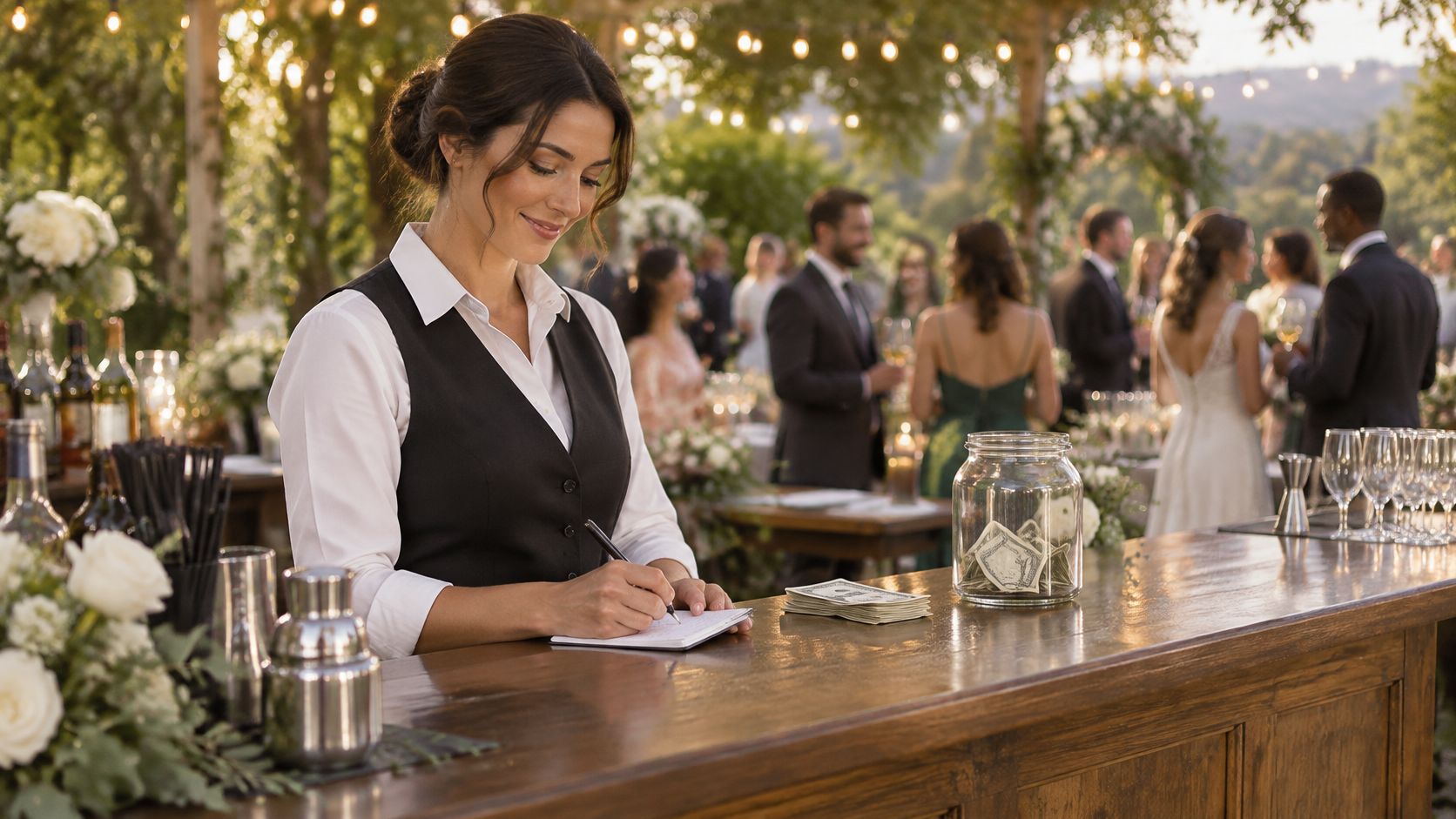
Illustrative tip-jar setup. BeeHive uses tip jars only with client and venue approval; tipping remains optional.
With dry-hire service, a more expensive bottle does not automatically mean more bartending work. If you choose a percentage, write down the service subtotal you are using and exclude host-purchased alcohol. For a flat amount, use the actual staffing count in your proposal.
Worksheet line: Flat, $35 per bartender, $70 total, head bartender splits it, handed over at the end of the reception. Someone other than the couple should be able to read that sentence and act on it.
Adjust the Tip for Workload and Staffing
Start from the staffing plan. Bartender staffing is matched to the guest count, so the number of bartenders in your proposal is the basis for any per-bartender figure, and guest counts remain estimates rather than fixed capacity. If you're not sure whether your headcount calls for one bartender or three, our guide to how many bartenders you need walks through the ratio before you settle on a per-person amount.
Factors you may consider
Guest-to-bartender ratio: a crowded bar with a long queue is more sustained work than a comfortable one.
Continuous service: a bar pouring without a break across cocktail hour, dinner and dancing may involve more work than a short window.
Cocktail complexity: signature drinks that need shaking, muddling or layering slow every ticket.
Setup and breakdown: hauling equipment, icing tubs and packing out at midnight is labor, not atmosphere.
A late finish: consider the length and demands of the agreed shift.
Keep the amount optional
A short beer-and-wine service and a longer cocktail reception involve different workloads, but neither creates a required tip. Staffing and contracted service should be adequate regardless of gratuity; a larger tip does not solve an understaffed bar.
Who Covers the Tip and When a Tip Jar Fits
At a hosted wedding, discuss gratuity with the bar provider before the event so guests are not put under pressure to contribute. The hosts can handle an optional tip privately.
BeeHive’s published policy is straightforward: tips are optional and appreciated, and tip jars require both client and venue approval. A jar should never be added automatically.
Three questions settle the policy before the wedding:
Does the venue permit tipping at all? Some contracts restrict it outright.
Is a visible tip jar appropriate here? Venue rules and the payment model both factor in.
Has a mandatory service charge already been distributed to staff? Discuss the host’s preference and venue policy before approving any jar.
If a jar is approved, agree where it will sit and how to make clear that drinks are hosted and tipping is optional. If you prefer no jar, tell the team during planning.
Ask before you display: is tipping permitted, is a jar appropriate, and has any service charge already reached the staff?
The same reasoning travels. If you're researching castle weddings at Count Kálnoky's Estates or any venue abroad, check local tipping customs, the contract and the venue’s house rules, and ask the coordinator rather than importing an assumption.
Confirm Your Tip Plan Before the Wedding
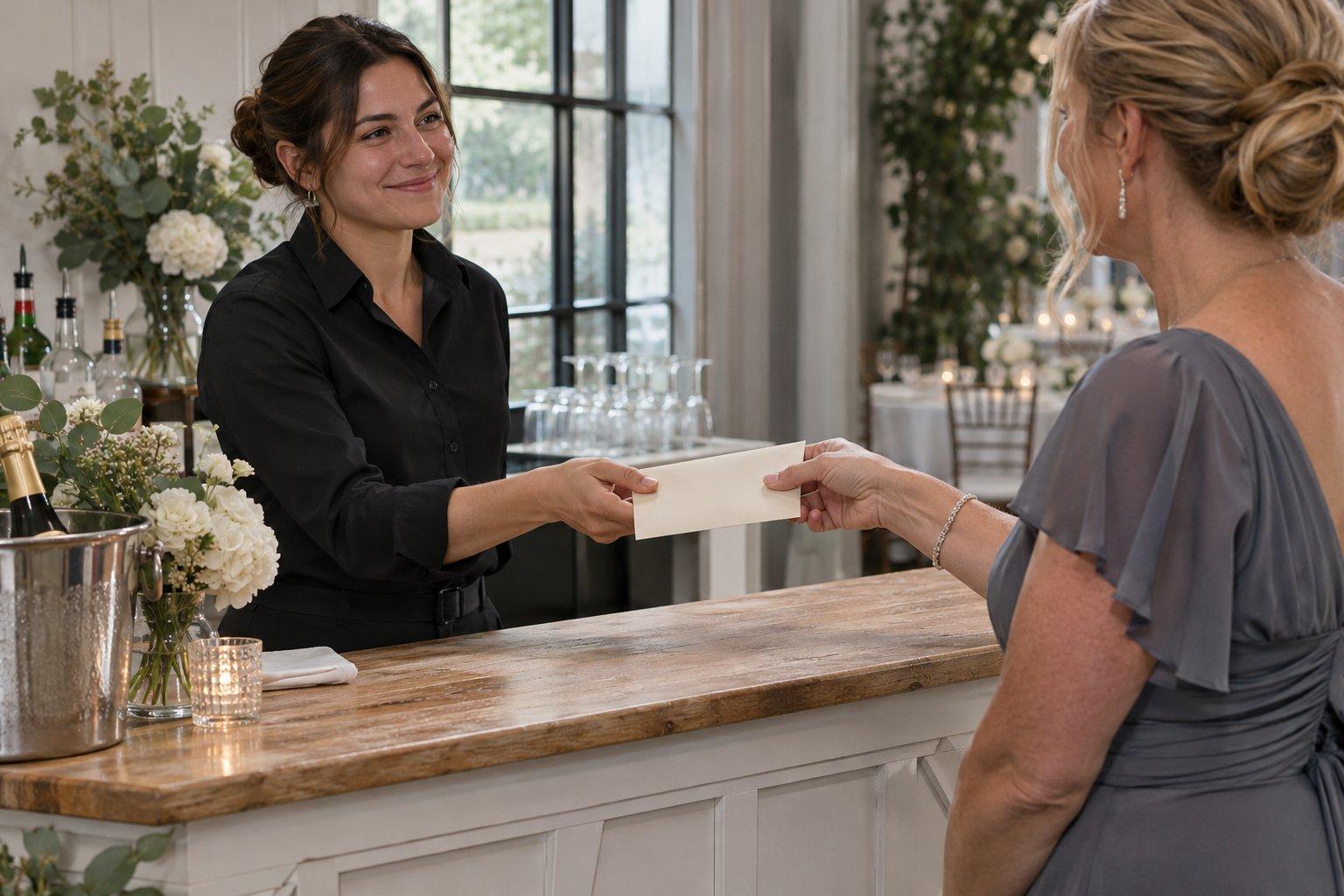
Choose a trusted person to handle any gratuity after service. Confirm the recipient and whether it will be divided among the team. Put the amount and handoff in your planning notes.
Read the proposal and invoice for service charges, included gratuity, and who receives each amount.
Record one method with the per-bartender figure and the total, so the number can't drift.
Name one trusted person such as the planner, coordinator or a family host to hold the gratuity.
Prepare a labeled envelope or a documented electronic tip for the end of the reception, never cash left unattended on the bar.
Get client and venue approval first if a tip jar is still on the table, and discuss any gratuity already included in the agreement.
That handoff keeps the moment discreet and stops guests from being asked to cover something the couple has already handled. It also gives the bar team a clean, documented close to a long shift.
Booking runs the same way. Both a signed contract and a 25% deposit are required to reserve the date, and the proposal states the total, the remaining balance and the payment deadline. Our bartender-only service starts at $350 and includes two hours of bar service with a two-hour minimum, which gives you a concrete service fee to calculate any percentage against. If you're still comparing structures, our guide to how to hire a bartender for a wedding covers what belongs in the agreement. For a wider pass over the other vendors on the day, this reception vendor checklist for 2026 is a practical way to line up every handoff, tips included.
BeeHive Mobile Bar runs dry-hire mobile bar packages and separate bartender-only service for weddings across Orange County and nearby Southern California, with staffing tailored to your guest count, menu and service plan and a proposal that names every charge before you sign. If you'd rather settle the tip question alongside the service plan than guess at it later, request a personalized quote at BeeHive Mobile Bar and we'll walk through scope, hours and handoff together.